Best bottom colors for your pool

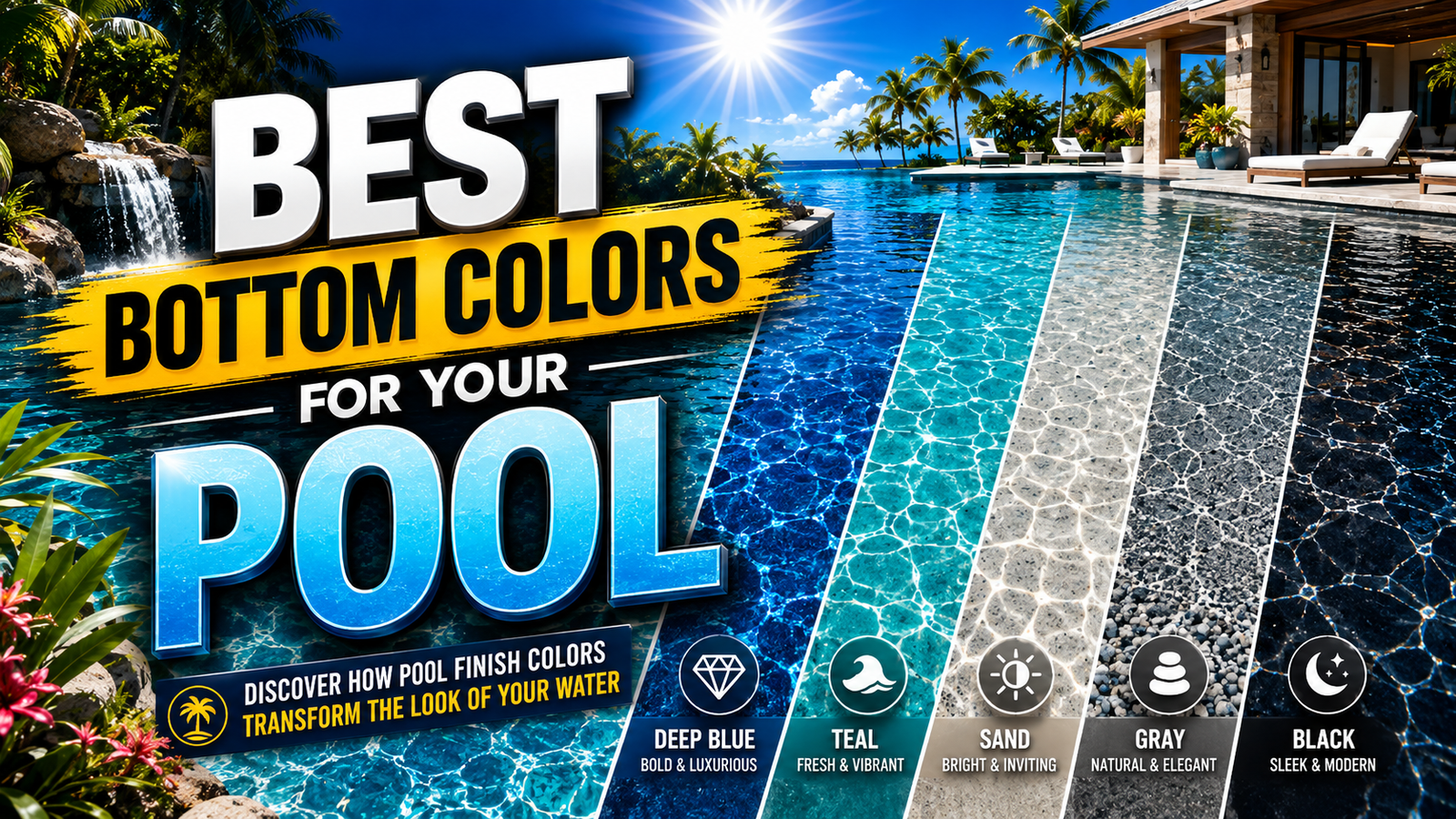
Choosing the right shade for a pool’s interior goes far beyond simple aesthetics. While the first impression usually focuses on design, the reality is that the bottom color dictates water behavior, temperature regulation, and the physical dynamics of daily maintenance.
Below is a breakdown of how light, chemistry, and physics interact with different shades, revealing details that are rarely taken into account during construction.
The Phenomenon of Dark Tones (Black and Navy Blue)
Very dark colors have gained popularity for their modern appearance, but they drastically alter the physics of the aquatic environment.
- The mirror effect: Unlike light bottoms, a black finish prevents light from penetrating and bouncing back to the surface. Instead, the water acts as an almost perfect mirror that reflects the sky, trees, and surrounding architecture.
- Refraction hazards: This optical effect destroys depth perception. The human eye loses the ability to visually calculate where a step ends and where the deep area begins, which alters basic structural safety.
- Passive thermal collectors: A dark bottom massively absorbs solar radiation. This can naturally raise the water temperature by several degrees. However, warmer water accelerates evaporation and depletes free chlorine much faster, demanding constant chemical replenishment.
The Camouflage of Earth Tones (Sand, Beige, and Dark Green)
Sand or quartz tones are designed to mimic natural environments. When interacting with water and sunlight, a sand-colored bottom visually produces a light emerald or turquoise hue.
- The microscopic hideout: The biggest challenge with these colors is camouflage. Algae spores in their early stages have shades that blend perfectly with earthy or greenish bottoms. When the water begins to fall out of balance, it is practically impossible to detect an algae bloom with the naked eye. By the time the color change alerts to a problem, the chemical imbalance is already severe and requires aggressive shock treatments.
The Science Behind Light Tones (White and Light Blue)
Classic white and pure light blue remain the undisputed kings in terms of water and chemical efficiency.
- Immunity to photodegradation: The sun’s ultraviolet rays, combined with the constant oxidizing power of chlorine, act as a relentless bleach. Dark pigments suffer a rapid and often uneven fading process. A white bottom, by its very nature, does not show this degradation, significantly extending its lifespan before requiring surface restoration.
- Early diagnosis: A light bottom functions as a clinical canvas. Any minute imbalance, whether it is dust, heavy metals precipitating (like copper staining green or iron staining brown), or the birth of algae, becomes immediately apparent. This allows for precise and rapid chemical interventions with minimal product doses.
- Night lighting efficiency: A light bottom maximizes refraction. The light from a single underwater fixture will bounce off white walls and fill the entire water volume evenly. In dark bottoms, light is absorbed, forcing the installation of triple the fixtures to achieve the same level of nighttime illumination.
The choice of pigment directly affects thermal retention, material longevity, and the chemical stress of the water. By understanding the behavior of light and matter, choosing a color ceases to be a decorative issue and becomes the first line of defense for the preservation of the structure.