How to know if a fabric is really suitable for your pool POOL COVER FABRIC

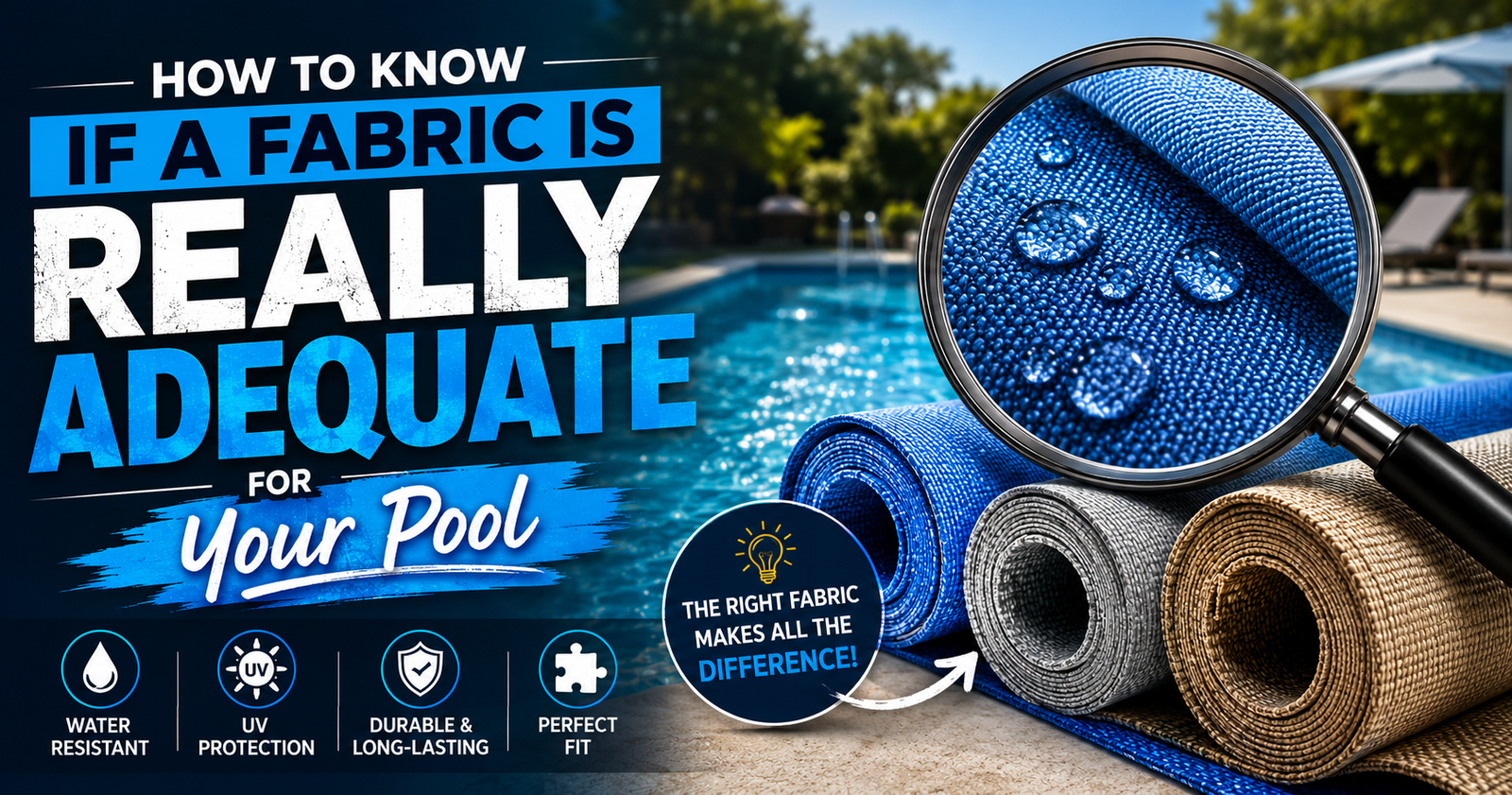
Choosing the right cover goes far beyond looking for a thick material that prevents branches or leaves from falling. The true impact of a cover is found in its microscopic structure and how it constantly interacts with the chemistry of the contained water.
THE SECRET OF MICRONS AND PHOSPHATES
Most mesh fabrics are evaluated by their tensile strength, but the critical data is the pore size. A fabric with a dense weave close to 90 microns manages to block pollen and fine dust from the atmosphere. This is fundamental because dust carries high amounts of phosphates, which act as the main food for algae spores. Blocking the entry of this fine dust directly alters the chemical stability of the water, keeping the levels neutral for longer.
THE ATTACK OF CORROSIVE GASES
There is a destructive element that weakens solid covers from the surface of the water upwards. Disinfection byproducts generate gases known as chloramines, which become trapped between the liquid and the fabric. If the material does not have a barrier or an internal treatment resistant to chemical gassing, these vapors slowly corrode the fibers. This is the reason why fabrics that seem extremely thick begin to show micro-fissures that end up tearing the canvas without having received external impacts.
THE SEAM TRAP
A cover usually fails first at its junction points rather than in the center of the fabric. Fabrics assembled with standard polyester threads quickly lose integrity due to friction, constant humidity, and ultraviolet rays. A truly suitable fabric requires high-frequency heat-sealed joints or the use of polytetrafluoroethylene threads, designed to withstand extreme solar radiation and highly acidic environments without rotting or disintegrating.
THERMAL CONTROL THROUGH BOTTOM OPACITY
The tone of the top face fulfills a purely visual function, but the color of the reverse side determines cellular proliferation in the water. A completely black and opaque bottom layer stops the penetration of light in its entirety, paralyzing any photosynthesis process below the surface. Fabrics with clear, blue, or semi-translucent backings filter diffuse light, which raises the internal temperature and turns the pool into a perfect incubator for microorganisms, demanding greater chemical intervention later.
THE ULTIMATE RECOMMENDATION FOR CHOOSING
When selecting the material, the decision must be based on the integration of all these technical elements, leaving aside only the aesthetics or the weight of the canvas.
The technical recommendation is to opt for a solid multi-layer fabric that necessarily has a barrier resistant to chemical gassing and a reverse side of total black opacity to block any light spectrum. In scenarios where a mesh fabric is required due to excessive rain or snow, the choice should be directed to a 90-micron microfiltration weave to stop the entry of phosphates.
Finally, it is essential to inspect the assembly architecture. Any fabric joined with conventional threads must be immediately discarded, demanding instead heat-sealed seams or joints reinforced with polytetrafluoroethylene thread. A canvas designed under these structural parameters not only protects the environment but actively works to preserve the internal balance of the water, drastically reducing the need for corrective treatments.