How to know if there is really a chemical balance and everything is working correctly

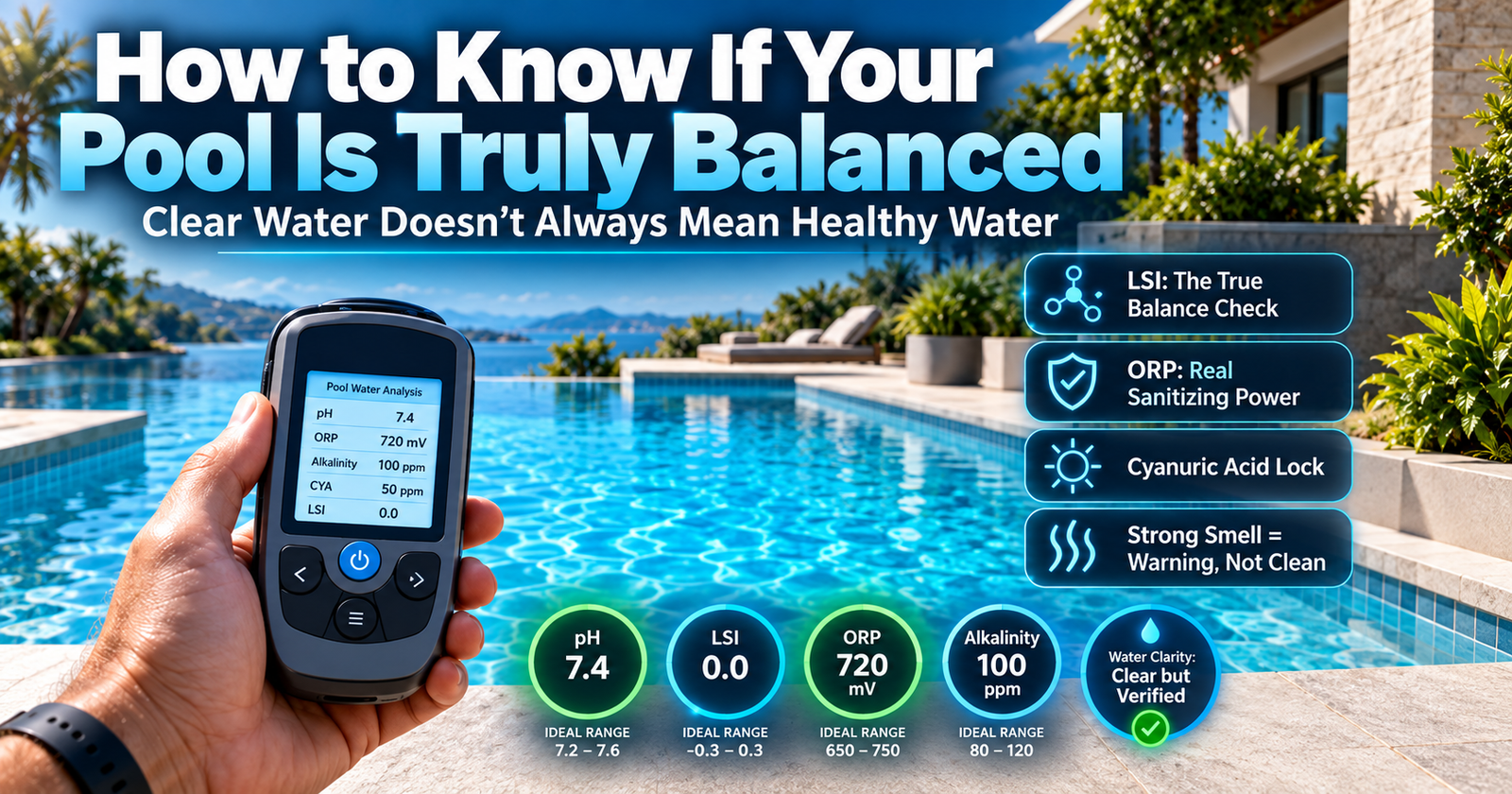
Crystal clear water often deceives the eye, creating the false illusion that the aquatic environment is in perfect condition. However, visual clarity is not a reliable indicator of chemical health. To accurately determine the state of the water, it is necessary to go beyond conventional measurements and understand the invisible interactions that occur at the molecular level.
THE TRUE INDICATOR: THE LANGELIER SATURATION INDEX (LSI)
Most basic evaluations focus solely on measuring acidity and sanitizer. However, true equilibrium is determined by the Langelier Saturation Index, a mathematical formula that evaluates temperature, acidity level, total alkalinity, calcium hardness, and total dissolved solids.
- An exact result of zero means a perfect chemical balance.
- A negative value indicates that the water is aggressive and corrosive. It will begin to extract calcium from surfaces, slowly destroying the plaster and metals.
- A positive value indicates that the water is oversaturated and will cause scale buildup in the plumbing. This reduces water flow and drastically shortens the lifespan of circulation equipment.
THE CHEMICAL LOCKDOWN
There is a phenomenon rarely documented in general use called cyanuric acid lock. This component acts as a sunscreen, preventing ultraviolet rays from evaporating the cleaning agents. However, when the levels of this acid cross a specific threshold, the sanitizer becomes trapped at the molecular level.
The result is a continuous false positive: conventional tests will show high and adequate levels, but the water will be biologically unprotected. Microorganisms will thrive even though the numbers suggest otherwise. The only solution is to dilute the water, as this protective compound does not evaporate naturally.
REACTION SPEED AND ORP
Another advanced metric that reveals the truth about how the ecosystem functions is the Oxidation-Reduction Potential. While standard tests measure the amount of product present in the water, this metric measures the speed and electrical force with which contaminants are being eliminated.
If there are high levels of dissolved solids from organic debris accumulated over the years, the water becomes dense at a microscopic level. There might be a perfect acidity level on paper, but a low electrical force reveals that the protective molecules are moving too slowly to be effective.
THE FALSE ALARM OF THE SMELL
A strong odor does not mean the environment is clean or oversaturated with products. This scent is caused by byproducts formed when the active element has already collided and reacted with contaminants, such as sweat or body oils. When this smell is noticeable, it means exactly the opposite: the cleaning power has been exhausted, and extreme oxidation must be forced to break apart those byproducts and restore neutrality.
THE FINAL RECOMMENDATION: PREVENTIVE MANAGEMENT AND STRATEGIC PURGING
After understanding that basic tests tell only a fraction of the story, the technical recommendation is not to add more reactive chemicals when the water presents issues, but to shift toward a microscopic prevention approach.
The first recommended action is incorporating specialized enzymes into the maintenance routine. These biological catalysts are responsible for devouring the inactive organic load, such as oils and sunscreens, before the primary sanitizer has to act. By removing this organic barrier, the oxidation force is freed up, thus preventing the formation of foul-smelling byproducts and maintaining an optimal reaction speed.
The second fundamental measure is establishing a scheduled water purging routine. Instead of keeping the same volume of water for years and fighting the resulting chemical density, the most advanced practice involves replacing a small percentage of the water periodically. This action mechanically dilutes inorganic dissolved solids and accumulated cyanuric acid, elements that no standard filtration can remove.
Finally, it is imperative to stop measuring levels in isolation. The Langelier Saturation Index must always be calculated by adjusting the values according to seasonal temperature changes. Keeping this index leveled and reducing the chemical density of the water through strategic dilutions is the only scientific guarantee that the ecosystem will operate safely, prolonging the life of the structure and preventing problems that are undetectable to the naked eye.