Florida’s Dry Season and the White Crust on Your Pool Tile: Calcium Scale Explained

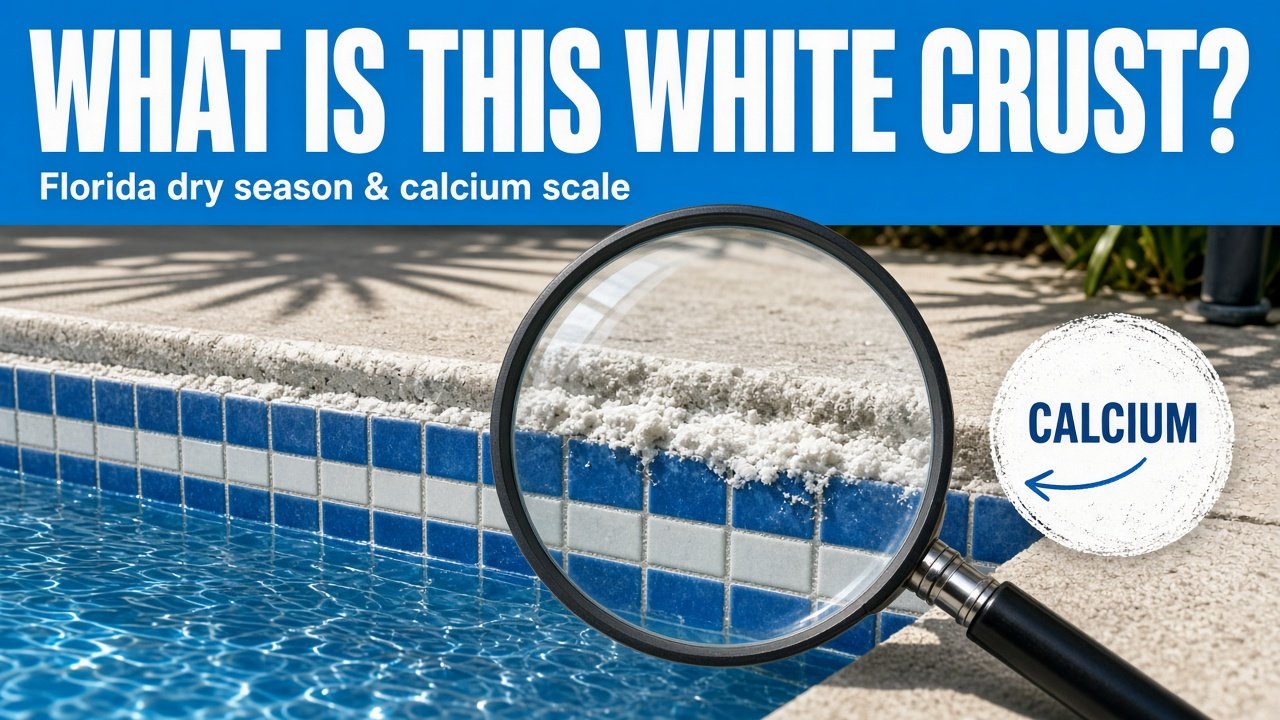
Have you noticed a white, crusty line forming along your pool tile this fall? Or a rough, gritty feel on steps and walls? Many Florida pool owners blame their water source or think it’s just dirt. In reality, fall’s dry season creates the perfect conditions for calcium scale, and most people don’t connect the two until the buildup is hard to remove. If you’re dealing with calcium scale in pool issues in Brandon or nearby Tampa Bay communities, this guide is for you.
What Is Calcium Scale?
Calcium scale forms when dissolved calcium in your water comes out of solution and deposits as a hard mineral, mostly calcium carbonate. It appears as white or grayish crust on tile, stone, waterfalls, salt cells and even inside heaters and pipes. Florida water, often sourced from limestone aquifers, can already carry a lot of calcium.
Why Fall Is Scale Season in Florida
From October through spring, Florida enters its dry season. Rain becomes less frequent, and evaporation can increase thanks to drier, breezier weather. Here’s the key: when water evaporates, minerals stay behind. Every time you top off with fresh water, you add more calcium. Over weeks, the concentration climbs.
- Less rainfall to dilute pool water
- More evaporation from dry, windy cold fronts
- Frequent top-offs that add minerals
- Rising calcium hardness and total dissolved solids
The Chemistry Behind It
Whether water deposits scale depends on its overall balance, often measured with a tool called the Langelier Saturation Index (LSI). Factors include pH, total alkalinity, calcium hardness and temperature. High pH and high alkalinity push water toward scaling. Interestingly, scale is also more likely in hot spots, like inside heaters and salt cells, which is why these components can be damaged first.
Why Scale Is More Than a Cosmetic Problem
- It makes surfaces rough and can scrape skin.
- It traps dirt and algae, making the pool look dirty.
- It reduces salt cell efficiency and shortens its lifespan.
- It can lower heater efficiency and damage internal components.
- It may restrict flow in plumbing over time.
How to Prevent Fall Scale
- Test calcium hardness monthly during the dry season.
- Keep pH balanced, generally in the 7.4–7.6 range for most pools.
- Control total alkalinity so pH doesn’t drift upward.
- Use a scale or sequestering product if your water is naturally hard.
- Inspect your salt cell regularly and clean it as needed.
- Reduce evaporation with a cover, so you add less mineral-rich water.
How to Remove Calcium Scale in Your Pool
Light scale on tile can often be removed with a pumice stone made for pools (on suitable surfaces only) or a scale-removing tile cleaner. Heavier deposits may require professional bead blasting. If calcium hardness is very high, partially replacing the water can help, but in Florida this should be done carefully, as draining a pool can cause structural issues with high groundwater.
Calcium Scale vs. Other White Deposits
Not every white mark on your pool is calcium carbonate. Telling them apart helps you choose the right solution. One common look-alike is calcium silicate, an older and harder scale that is grayish and very difficult to remove at home; it usually requires professional treatment. Another is a white film from dried pool chemicals or salt, which wipes away easily with water.
A simple home test is to place a few drops of diluted muriatic acid on a small scraping of the deposit, using gloves and eye protection. If it fizzes, it’s likely calcium carbonate. If nothing happens, it may be calcium silicate or another mineral. Also watch for white flakes coming out of the return jets. These often come from scale breaking loose inside a heater or salt cell, a sign the equipment needs inspection.
Identifying the deposit correctly saves you from scrubbing the wrong way, wasting products or damaging your pool’s finish.
Frequently Asked Questions
What causes calcium scale on pool tile?
High calcium hardness, high pH and evaporation leave calcium behind at the waterline.
Can I remove calcium scale myself?
Light scale comes off with a pumice stone or scale remover; heavy scale is best left to a professional.
Keep reading: learn about why your pool loses water in fall and chlorine levels in winter.
Conclusion
Fall’s dry season concentrates minerals in your pool as water evaporates and new water is added. Without balanced chemistry, that calcium ends up on your tile, steps and equipment. Understanding this seasonal pattern helps you prevent buildup before it becomes costly.
Final Recommendations
Test calcium and pH regularly, use a cover to reduce evaporation, and check your salt cell and heater for early signs of scale. Pro Quality Pools monitors your water balance every week and can spot scale early, protecting both your pool’s look and your equipment investment.
Need Help With Your Pool in Brandon and Nearby?
Pro Quality Pools is a family-owned pool cleaning company serving Brandon, Valrico, Riverview, FishHawk, Seffner and Dover, Florida. Explore our pool cleaning and maintenance services or contact us today for a free quote.