Mega designs or classic designs in pools what to think about before building if your budget is unlimited

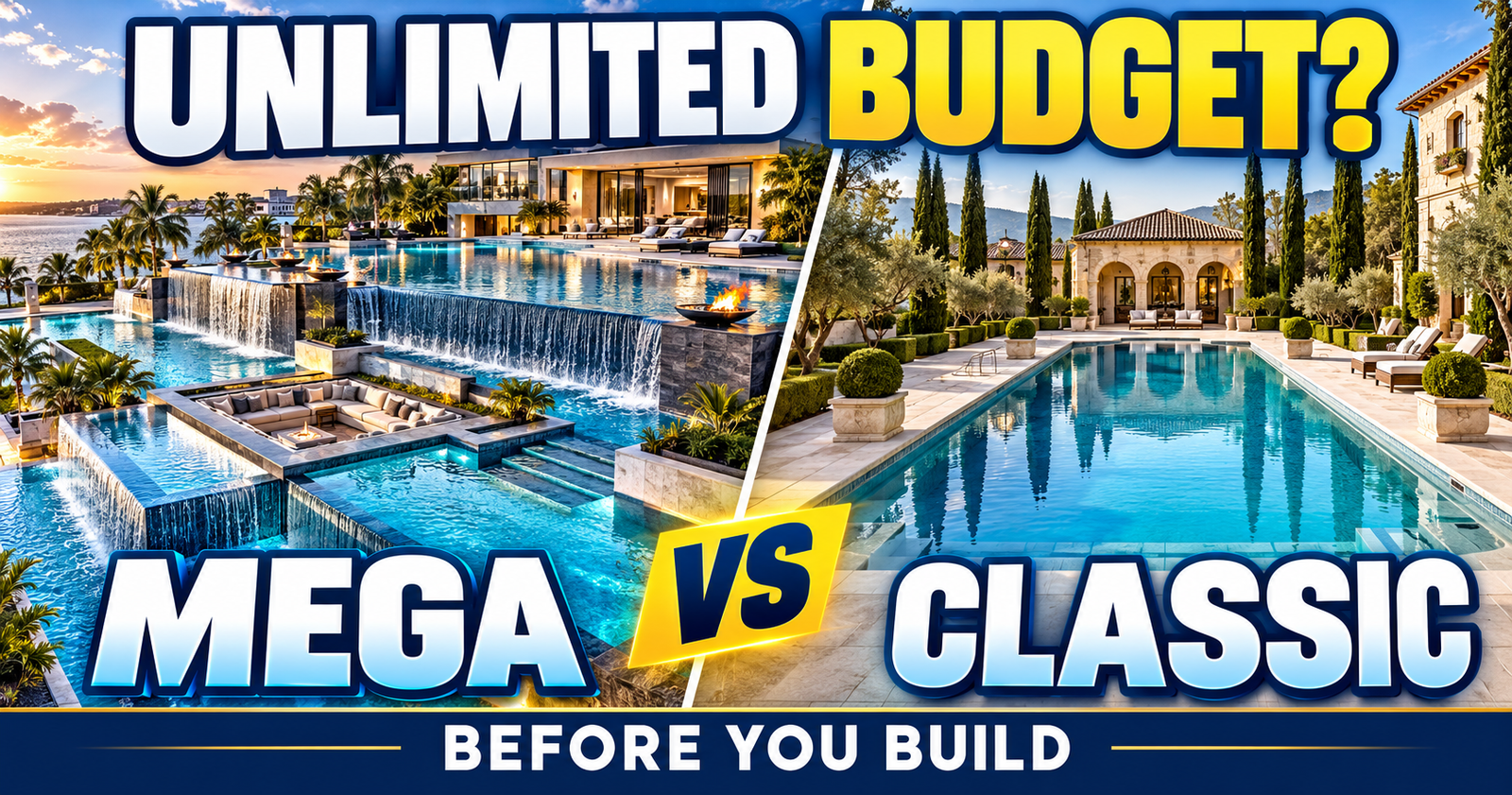
When there is no financial limit while planning luxury pool design ideas for a backyard aquatic space, the conversation usually revolves around visual impact: infinity edges that blend into the horizon, floating islands in the center of the water, grottos with waterfalls, or organic shapes full of curves. However, behind the magazine-worthy aesthetics lies an unforgiving physical and chemical reality. Water does not care about budgets; it responds solely to circulation, temperature, and the composition of the materials surrounding it.
When exploring luxury pool design ideas, choosing between a mega design (complex, with multiple levels and features) and a classic design (geometric, clean, and symmetrical) is not just an architectural decision. It is a decision about how that body of water will behave every single day after construction is complete.
Luxury pool design ideas and the secret of dead zones and invisible hydraulics
For pool water to remain crystal clear and safe, it needs to be in constant, uniform motion. Filtration systems rely on chemically treated water reaching every corner of the shell to push debris toward the skimmers and drains.
In a classic rectangular design, the hydraulics are predictable. Return jets create a clean, circular flow where the water sweeps the walls without obstacles. In contrast, in a mega design filled with nooks, submerged seating, swim-up bars, and tight curves, that current is broken, creating what are known as dead zones.
A dead zone is a pocket of water where the current simply does not reach. Even if the rest of the pool has perfect sanitizer levels, the water in that specific corner stagnates, heats up faster, and depletes its chlorine within hours. It is right there—behind a decorative step or underneath a rock waterfall—where invisible algae spores germinate before invading the entire pool.
The air paradox: why waterfalls alter water chemistry
Some of the most requested elements in high-budget projects are laminar jets, weeping walls, and infinity edges. Visually, they are hypnotic, but from a water chemistry standpoint, they trigger a little-known phenomenon called outgassing through aeration. Keep this in mind when comparing luxury pool design ideas with water features.
Every time water falls, crashes, or gets agitated in the air, it releases dissolved carbon dioxide. By losing this gas, the pH level of the water rises constantly and inevitably, becoming more alkaline. When the pH is too high, two things happen:
- Chlorine loses its strength: At a high pH, chlorine enters a sluggish state where it can barely destroy bacteria or algae, no matter how much product is added.
- Scale appears: The natural calcium in the water stops being liquid and solidifies, clinging to walls, luxury tiles, and the inside of heaters in the form of rough white crusts.
In a pool with multiple water features running several hours a day, chemical balance requires pinpoint monitoring and continuous compensation with acid reducers to prevent the design itself from deteriorating the finishes.
Ultra-luxury materials in luxury pool design ideas and their silent footprint on the water
With an unlimited budget, it is common to dismiss traditional plaster in favor of exotic natural stones or imported glass tiles. However, each material interacts with the water in ways rarely mentioned in architectural catalogs:
- Porous natural stone (travertine, slate, limestone, or sandstone): Unlike porcelain or polished quartz, natural stone has millions of micro-pores. These pores act as tiny greenhouses for the microscopic roots of algae, making them immune to surface brushing. Furthermore, if the pool uses a saltwater chlorination system, the salt penetrates those pores, crystallizes as it dries in the sun, and slowly crumbles the stone layer by layer from the inside out.
- All-glass tile: Glass itself is an inert, extraordinarily hygienic surface where nothing can take hold. The real challenge is not the glass pieces, but the linear miles of grout holding them together. If conventional cementitious grout is used instead of chemical-grade epoxy resin, the water will seek out the calcium in those joints, slowly dissolving them until the glass tiles start popping off on their own.
- Perimeter overflow (Lautner-style or zero-edge): In these pools where water spills flush with the deck on all four sides into a hidden slot, any leaf or insect disappears from sight in seconds. However, all that organic matter does not vanish from the system; it travels into an underground surge tank. If that hidden tank is not designed with wide, easy access for manual cleaning, it becomes a reservoir of decaying leaves that consumes all the sanitizer before the water ever returns to the pool.
The mirage of tanning ledges (Baja shelves)
Shallow ledges—where the water is barely 4 to 8 inches deep to place lounge chairs inside the pool—are almost mandatory in modern designs. What few anticipate is their thermal and biological behavior. Even popular luxury pool design ideas have a hydraulic cost.
By having such a thin sheet of water directly exposed to the sun, that area reaches much higher temperatures than the rest of the pool. Ultraviolet (UV) rays destroy free chlorine at an accelerated rate in shallow water. Within a few hours of intense sunlight, that ledge is left without sanitizing protection and turns into a thermal incubator where ambient dust and sunscreen oils stick to the floor much more easily than in the deep end.
Technical comparison: Mega design vs. Classic design
| Behavioral Factor | Classic Design (Geometric / Symmetrical) | Mega Design (Organic / Multi-level) |
| Water circulation | Uniform and predictable; no stagnant corners. | Requires dedicated auxiliary pumps just to move water in caves, islands, and curves. |
| pH stability | Very high; the water surface remains calm. | Low; turbulence from waterfalls and overflows raises the pH daily. |
| Evaporation and heat loss | Minimal and easy to control (allows hidden automatic covers). | High; water launched into the air by fountains or infinity edges evaporates quickly. |
| Automated cleaning | Robotic cleaners map exact routes at 90-degree angles. | Drop-offs, submerged benches, and pillars block or confuse automated equipment. |
Final recommendations on luxury pool design ideas before approving the blueprints
If the budget allows for building any vision, the best investment is not adding more decorative features, but incorporating invisible preventive engineering that supports the chosen architecture:
- Independent hydraulic loops: If opting for a mega design with waterfalls and infinity edges, these should not rely on the same pump that filters the pool. They must have separate plumbing and motors so they can be turned off without stopping main filtration, preventing the pH from spiking 24 hours a day.
- In-floor returns in critical areas: On tanning ledges, wide steps, and submerged benches, it is essential to install return fittings directly in the floor that push water from the bottom up, eliminating dead zones at the root.
- 100% solid epoxy grout: If glass tile or stone finishes are chosen, requiring industrial epoxy grout ensures that the water can never wear down the joints or alter its own chemistry by leaching minerals from the walls.
- Automated CO2 or acid dosing systems: For pools with heavy water features, integrating a system that automatically injects micro-doses of carbon dioxide or pH reducer will keep the water balanced without wearing out equipment or clouding luxury finishes.
Conclusion
An unlimited budget offers the privilege of choosing without restrictions, but true sophistication in a pool is not measured by the number of special effects it has on opening day, but by how gracefully it ages. Classic designs have survived for decades because they work in favor of the physical laws of water, achieving visual and sanitary purity with effortless grace. Mega designs, on the other hand, can be extraordinary works of art, provided their exterior beauty is backed by hydraulic planning that understands a simple truth: for water to look perfect, it needs to flow without obstacles. The best luxury pool design ideas pair beauty with sound hydraulics.
Looking for luxury pool design ideas that will also stay easy to maintain? Our pool services team can help you plan, so contact us to talk it through. For water safety guidance, see the CDC healthy swimming resources.