Real price in Florida of a pool construction investment

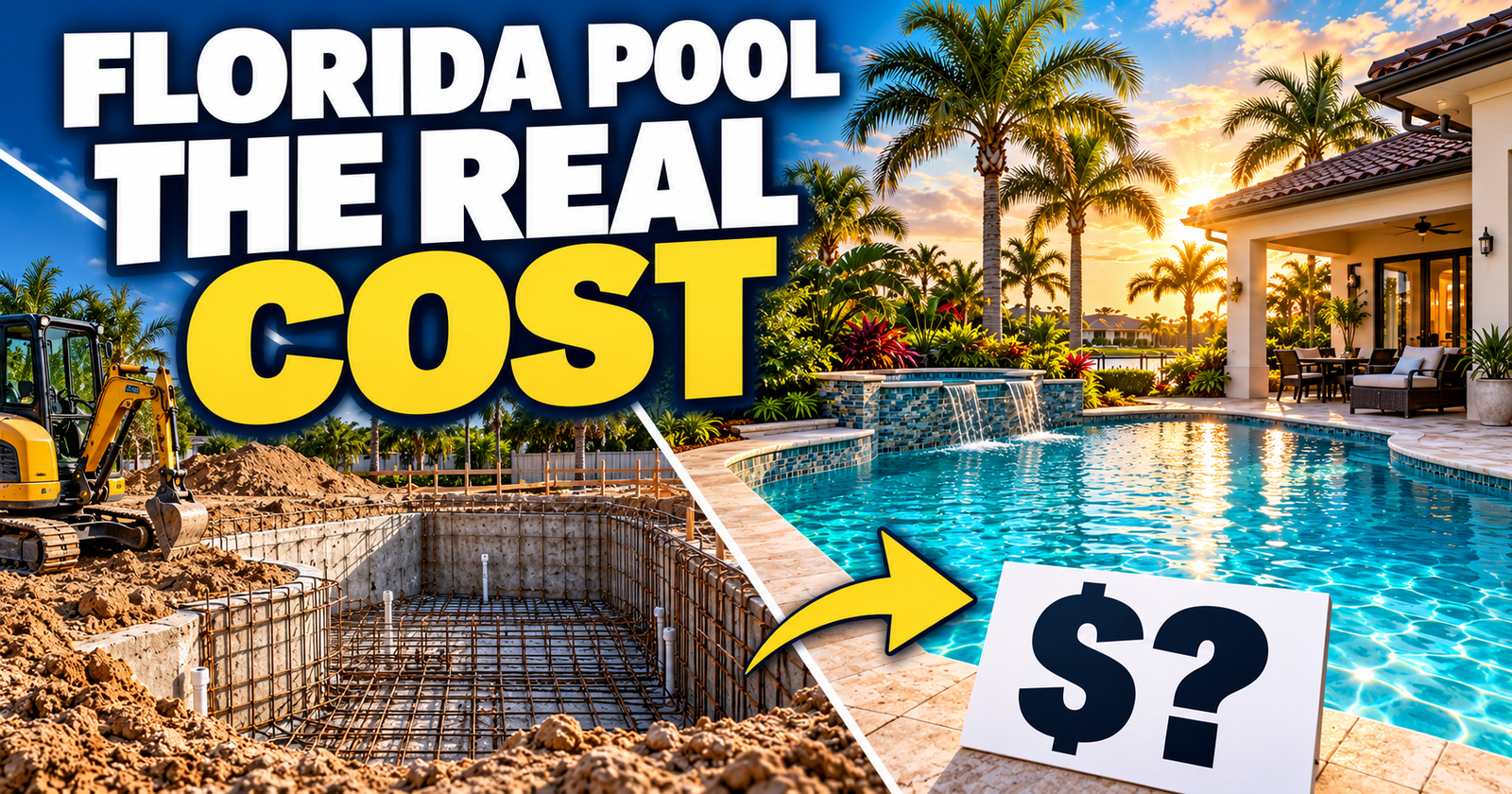
The pool construction cost Florida homeowners face in the Sunshine State rarely matches what entry-level advertisements promise. While promotional brochures often display attractive starting figures around $45,000, the financial reality upon project completion is quite different. The actual pool construction cost Florida for a complete, functional residential project ranges between $65,000 and $120,000, easily exceeding $150,000 when custom designs, hydrotherapy areas, or high-end finishes are integrated.
The gap between the initial estimate and the final invoice is not necessarily due to overcharging, but rather to the geological, climatic, and regulatory peculiarities of the peninsula. Furthermore, the decisions made during the excavation and material selection stages determine not only the construction cost, but also how much money and effort will be required to keep the water clean and the structure intact over the following decades.
Pool construction cost Florida: the base breakdown by structural material
In Florida, vinyl liner pools are uncommon because intense heat and ultraviolet radiation degrade the plastic rapidly. Consequently, the market is almost entirely divided into two construction systems: fiberglass and sprayed concrete (gunite or shotcrete).
| Feature | Fiberglass | Sprayed Concrete (Gunite / Shotcrete) |
| Average initial investment | $60,000 – $95,000 USD | $75,000 – $130,000+ USD |
| Execution timeline | 3 to 6 weeks | 3 to 6 months |
| Surface porosity | None (sealed gelcoat finish) | High to moderate (depending on the finish) |
| Long-term chemical demand | Low (does not alter water pH) | Medium to high (releases alkaline minerals) |
| Interior finish lifespan | 20 to 30 years before gelcoat renewal | 8 to 20 years depending on aggregate type |
1. Fiberglass pools
These are manufactured in an industrial plant as a single giant bowl-shaped piece and transported by truck to the property. Their interior surface is coated with a specialized resin called gelcoat, which lacks microscopic pores.
- The hidden impact on care: Because it is a completely smooth and non-porous surface, algae spores find no cavities in which to anchor themselves. Additionally, the material is chemically inert, meaning it does not react with the water or alter its acidity, reducing monthly chemical expenses by up to 30% compared to concrete.
2. Concrete pools (Gunite / Shotcrete)
These are built from scratch inside the excavation using a steel rebar grid over which a dense concrete mixture is sprayed at high pressure. They allow for any imaginable shape, size, or depth.
- The hidden impact on care: Concrete on its own is neither waterproof nor visually appealing, requiring a final interior coating (interior finish). This coating contains micro-pores where environmental dust and algae can lodge if water circulation fails for even a few days.
Underground and technical factors almost no one mentions
Several technical variables are rarely explained before signing a construction contract, yet they drastically alter both the build price and the future health of the water. These hidden items are a big reason the pool construction cost Florida climbs above the first quote.
Water table pumping (Dewatering) and the hydrostatic valve
Across much of Florida, especially near the coasts or wetland areas, groundwater appears after digging barely five feet deep. To build the structure in a dry environment, builders must install a temporary pump system that extracts thousands of gallons of water day and night for weeks. This process, known as dewatering, adds between $2,500 and $6,000 to the budget if not accounted for upfront.
Furthermore, that same groundwater creates a physical phenomenon known as hydrostatic pressure. When the water table rises due to heavy rains, the water beneath the soil pushes the pool shell upward like a boat hull. If a pool in Florida is completely drained without opening a specialized fitting in the main drain called a hydrostatic relief valve, the entire structure can literally pop out of the ground and crack in half.
The trap of traditional white plaster (Marcite)
To lower the initial quote on a concrete pool, basic estimates include a traditional white plaster finish mixed with marble dust (marcite). Although it saves between $4,000 and $7,000 on construction day compared to quartz or polished pebble finishes, it is the most expensive material to maintain in the medium term:
- The alkaline curing phenomenon: During the first several months, traditional plaster constantly releases calcium hydroxide into the water. This causes the pH level to spike daily, requiring large amounts of muriatic acid and daily wall brushing to prevent dissolved calcium from adhering as rough scale.
- Accelerated wear: In Florida’s warm climate, basic plaster begins to erode, stain, and become porous within 7 to 10 years, demanding a costly resurfacing remodel much sooner than a stone aggregate finish (which remains intact for 18 to 20+ years).
The diameter of underground plumbing
An invisible technical detail for anyone looking at a blueprint is the diameter of the PVC pipes connecting the pool to the pumps and filters. To save on material costs, many standard builds use 1.5-inch piping.
However, requesting that all underground plumbing be built with 2-inch or 2.5-inch pipe increases the total construction cost by only $800 to $1,500, while completely transforming the physics of the system. Wider piping reduces water friction, allows variable-speed pumps to operate at much lower RPMs without straining, decreases mechanical noise, and permanently cuts the monthly electric bill.
Hydraulic “dead spots” in modern designs
Current architectural trends favor straight lines, 90-degree angles, shallow lounging areas (sun shelves or baja shelves), and wide steps. What is rarely pointed out during the design stage is that sharp corners interrupt the natural circular flow of the water.
If the builder does not install dedicated return jets specifically angled to push water into those corners and steps, circulation dead zones are created. During a Florida summer, when water temperatures easily exceed 86 °F (30 °C), any corner where water stagnates and fails to receive fresh chlorine becomes the exact starting point for mustard or green algae blooms within hours.
Mandatory complementary costs in your pool construction cost Florida budget
The water-filled shell represents only half of the investment. For the project to pass county municipal inspections and remain practical for daily use, three additional elements representing 25% to 35% of the total expenditure must be factored in: Budgeting for them early keeps your pool construction cost Florida realistic.
- The screen enclosure (Pool cage): This is the hallmark of Florida properties. Its cost ranges between $10,000 and $25,000, depending on size and roof style. Beyond keeping out mosquitoes, alligators, or frogs, it fulfills a vital chemical function: it blocks falling tree leaves and reduces the intensity of direct sunlight. Without this structure, the Florida sun destroys free chlorine in the water in under three hours, and submerged leaves release organic tannins that stain the surface and consume sanitizer.
- Perimeter decking and stormwater drainage: Building the surrounding deck costs between $7,000 and $20,000. In Florida, due to torrential summer downpours, concrete pavers installed over a compacted sand base are generally superior to continuous poured concrete, as they allow the ground to shift slightly without cracking and provide easy access if an underground pipe ever requires repair.
- State-mandated safety barriers: The Florida Residential Swimming Pool Safety Act requires every new pool to have strict child-drowning prevention measures in place before passing final inspection. This involves installing a perimeter fence at least 4 feet high with self-latching gates ($2,000 to $6,000), a removable mesh safety fence anchored into the deck, or certified alarms on all house doors and windows leading to the patio.
- The saltwater system myth: Adding a salt chlorine generator costs between $1,800 and $3,500. It is essential to understand that a saltwater pool is not chlorine-free; the equipment simply uses electrolysis to automatically convert dissolved salt into pure chlorine. While it eliminates the constant handling of liquid chlorine, the chemical process naturally raises the water’s pH, and the salt accelerates corrosion on soft natural stones (such as certain limestones) or nearby metal fixtures if they are not properly sealed.
Conclusion
Investing in pool construction in Florida is a residential engineering project that rarely falls below $70,000 to $90,000 once permits, sandy soil preparation, decking, and climate protection systems are included. The true cost of a pool is not measured solely on the day the water truck finishes filling it, but by the efficiency engineered beneath the ground. When corners are cut on the interior finish quality, pipe diameter, or strategic placement of return jets, those apparent construction savings turn into a perpetual expense of electricity, chemicals, and premature material wear. In the end, understanding pool construction cost Florida line by line is the best defense against surprises.
Final recommendations to plan your pool construction cost Florida budget
- Prioritize the interior finish and hydraulics over visual add-ons: If the budget is tight, it is wiser to skip artificial waterfalls or complex color-changing lights and invest that capital into a quartz or pebble interior finish and 2-inch plumbing. Lights can be upgraded years later; pipes buried under concrete and wall porosity cannot.
- Request a layout with zero blind spots: When reviewing the blueprint with the builder, ensure that every step, submerged bench, or sun shelf has its own dedicated return jet. Eliminating stagnant water zones will prevent 80% of recurring staining and algae issues.
- Install an oversized filter and a variable-speed pump: Ask the builder for a cartridge filter with a higher capacity than the minimum required for the water volume. A larger filter traps microparticles at lower pressure, requires far less frequent cleanings, and extends the lifespan of the pump.
- Demand clear excavation clauses in the contract: Before signing, verify in writing how costs will be handled if the excavator hits hard limestone or if extended groundwater pumping (dewatering) is needed, establishing maximum price caps to avoid mid-build financial surprises.
- Include a dedicated cleaner line and an overflow drain: In Florida, tropical storms can cause a pool to overflow in a single afternoon. Ensuring the design includes an automatic overflow grate at the upper waterline tile level will prevent water from flooding the deck and keep yard debris from entering the filtration system. Additionally, having a dedicated suction or pressure line installed in the center of the wall will make connecting automatic cleaning equipment much easier without relying on the skimmer baskets.
Ready to turn your pool construction cost Florida estimate into a real plan? Our pool services team is here to help, so contact us for guidance. For permit and safety rules, check the Florida Department of Health pool program.