How Do You Know if a Product is Good or Bad for Your Pool

Many people stand in front of the shelves at the pool store wondering if a product will actually work in their pool or if it’s going to end up causing more problems.
Those of us who clean pools see this every day. Some products work well and others create more issues than they solve. That’s why I’m going to explain clearly how to tell whether something is worth buying before you spend your money.
1. First thing you should check: Is it compatible with your pool?
This is the most important part and where most people go wrong.
Not every product works for every type of pool:
- If you have a vinyl liner, abrasive cleaners or ones with strong solvents can damage it.
- If it’s fiberglass, some products can damage the gelcoat over time.
- If it’s concrete, calcium and scaling become a whole different issue.
- Saltwater pools vs traditional chlorine pools: many products that work fine in one can be a disaster in the other.
Before buying anything, check:
- What type of pool you have
- What sanitizing system you use
- What exact problem you’re trying to solve
If the product doesn’t clearly state that it’s suitable for your type of pool, it’s best not to buy it.
2. Read the label carefully
It might seem boring, but it’s worth doing properly.
Look for clear information like “compatible with [your type of] pools”, the exact dosage according to your pool’s volume, incompatibility warnings, and whether it’s meant for saltwater or regular chlorine pools.
If the label is vague, mostly has nice pictures but little technical information, or doesn’t mention compatibility at all, it’s better to leave it on the shelf.
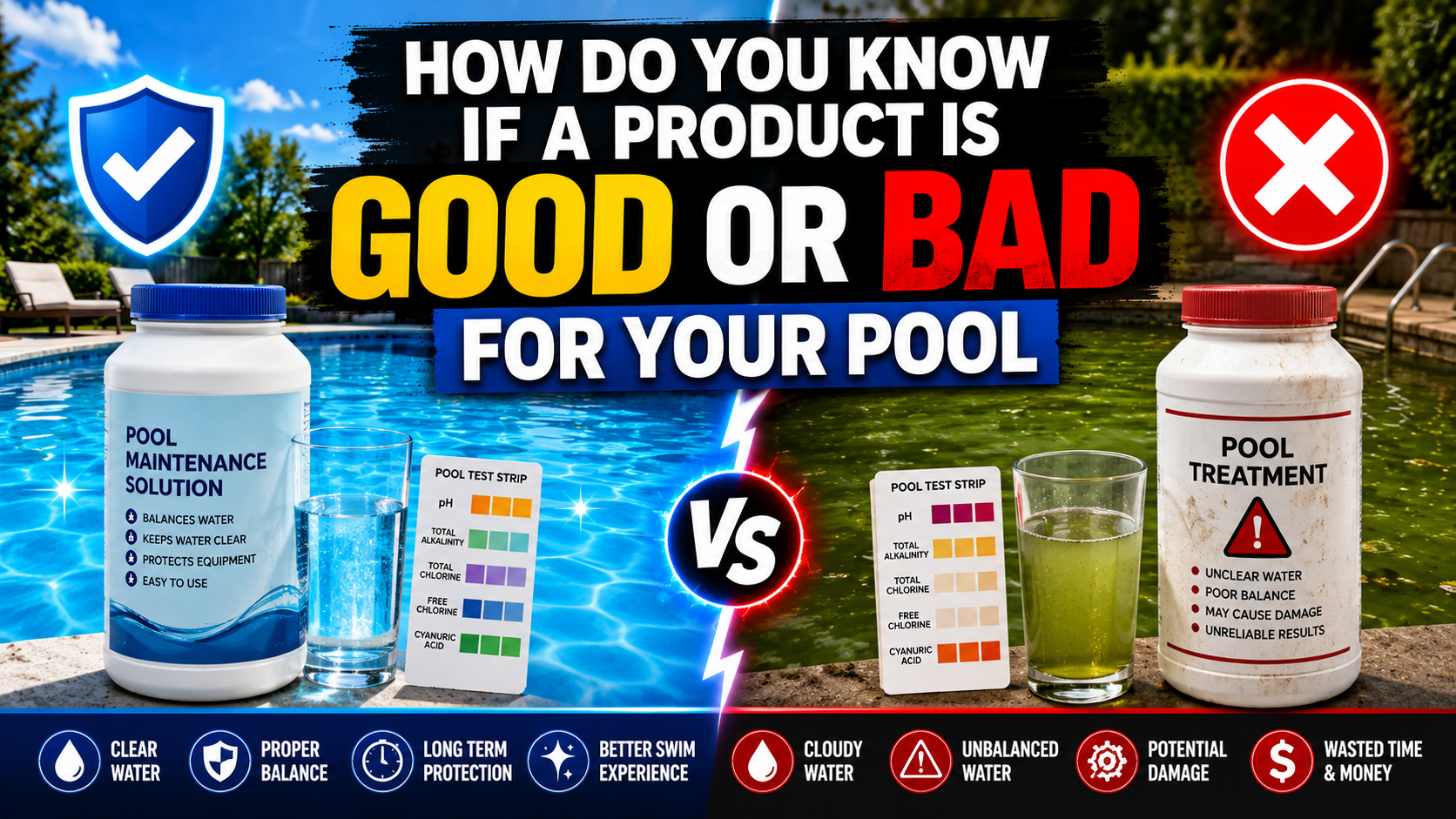
3. Signs that a product is good
When a product actually works, you’ll usually notice these things:
- The problem improves within 24–48 hours at most (not in 5 minutes — that’s usually just marketing).
- The water doesn’t get stranger than it already was.
- It doesn’t create persistent foam.
- It doesn’t leave stains on the walls or floor.
- Chemical levels stay stable.
- Swimmers don’t complain about stinging eyes or skin.
- It has good reviews from people who have pools similar to yours.
4. Signs that a product is bad (or even risky)
These are the things that usually mean a product isn’t working well:
- The water gets more cloudy or milky after using it.
- Foam appears and doesn’t go away even with the skimmer.
- Strange stains appear on the walls or floor.
- The water has a very strong or weird chemical smell.
- The filter gets clogged much faster than normal.
- Chlorine levels jump up or drop suddenly for no clear reason.
- Swimmers experience skin or eye irritation.
- Damage starts showing on equipment (pump, filter, heater, etc.).
For example, there are cheap clarifiers that promise crystal-clear water in just a few hours. If you use them, it’s very common for the water to look like milk the next day, forcing you to do a floc treatment and lose a lot of water.
5. How to test a new product without taking big risks
If you want to try something you’ve never used before, it’s smart to follow these steps:
- Do a full water test before adding anything.
- If it’s a chemical product, test it first in a bucket with some of your pool water (using a small dose).
- Look for real reviews from people who have pools similar to yours (check Facebook groups and forums).
- Always start with the minimum recommended dose.
- Wait at least 24–48 hours and test the water again.
If everything looks good, you can continue. If something seems off, it’s better to stop.
6. Common mistakes people make
These are the errors that happen very often:
- Buying the cheapest option without reading the fine print.
- Mixing products from different brands without knowing if they’re compatible.
- Using products made for commercial pools in residential pools (and vice versa).
- Not checking the expiration date (yes, pool chemicals do expire).
- Adding products without adjusting the pH first.
- Believing products that promise results in 5 minutes. In real pools, that almost never happens.
So… how do you know if a product is good or bad?
In the end, it comes down to this:
A product is usually good for your pool when it solves the problem you have, is compatible with your pool type and system, doesn’t create new problems, and has real feedback from people using it in similar conditions.
A product is usually bad when it promises too much and delivers too little, creates side effects, isn’t compatible with your pool, or only works while you’re using it and then everything goes back to being worse.
Your pool is an investment. A bad product doesn’t just waste your money — it often wastes your time, water, and even your desire to keep the pool.