Chemical or mineral sunscreen better for your pool

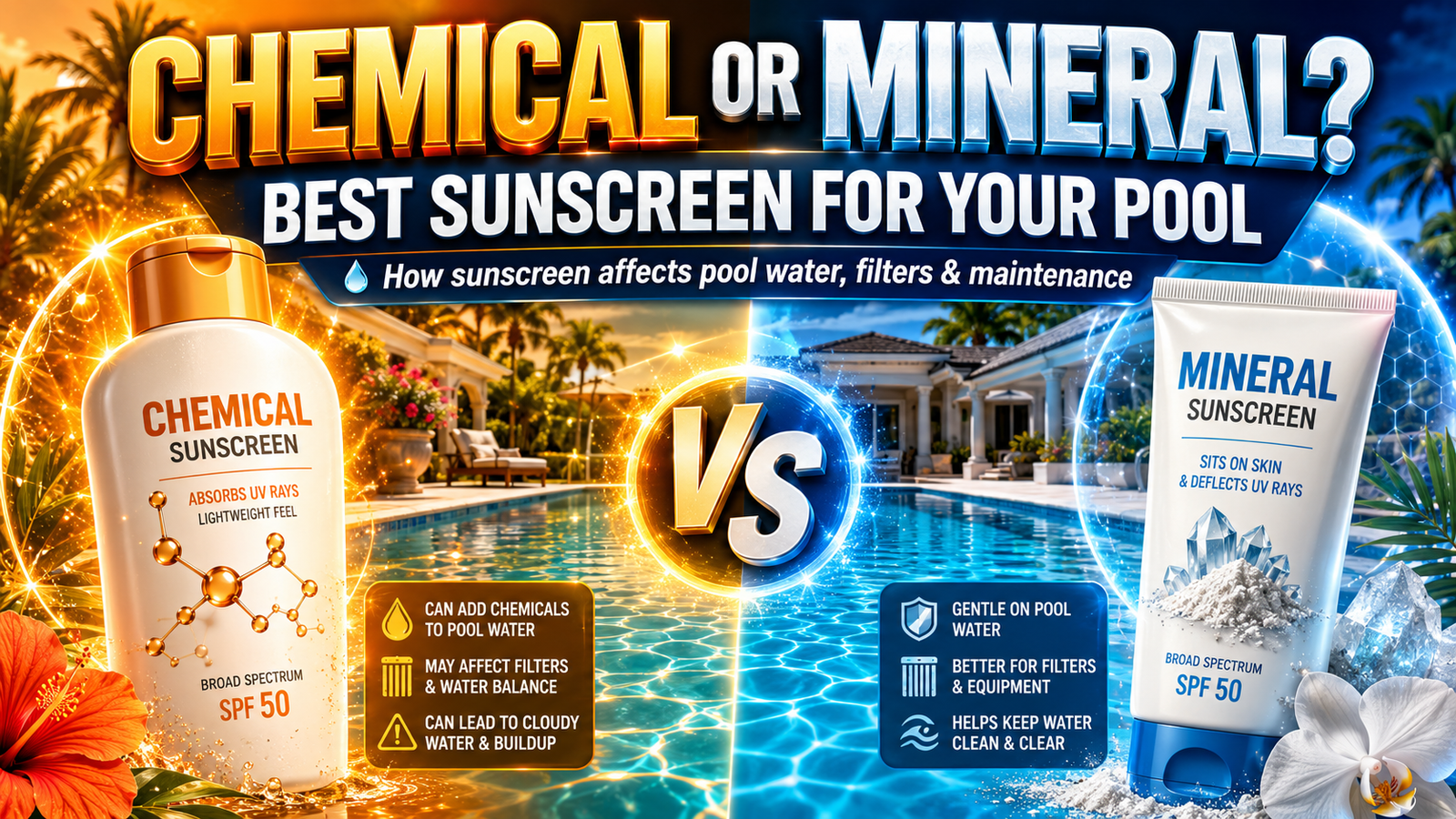
Water care goes far beyond measuring pH or adding chlorine. One of the elements that most alters the delicate chemical balance of an aquatic environment is something that silently enters on the skin of bathers: sunscreen. When evaluating the impact of these lotions from a technical maintenance perspective, a crucial distinction arises between how chemical formulas react compared to mineral ones.
To keep the water crystal clear, it is necessary to understand what happens at a microscopic level when these products wash off the skin.
The silent impact of chemical sunscreens
Chemical sunscreens (containing ingredients like oxybenzone, avobenzone, and octocrylene) work by absorbing UV radiation. However, when these compounds come into contact with treated water, they initiate a series of complex reactions.
These ingredients are organic compounds that chlorine immediately identifies as contaminants. In attempting to neutralize the sunscreen, the free chlorine in the water is rapidly consumed. This means that a pool with a high load of chemical sunscreen loses its disinfection capacity in a matter of hours, leaving the water vulnerable to the proliferation of invisible algae and bacteria.
The mechanical challenge of mineral barriers
On the other hand, mineral sunscreens use zinc oxide or titanium dioxide. These ingredients act as tiny physical shields that reflect light. From a water chemistry perspective, minerals are biologically inert. They do not react with chlorine or consume it aggressively.
The challenge with mineral sunscreens is not chemical, but mechanical. Being insoluble, these minerals wash off and float in the water as an ultra-fine powder. If the filtration system is not precise enough, this powder can cause slight cloudiness in the water.
Little-known facts about sunscreens and water
The interaction between sunscreens and the aquatic environment generates phenomena that are rarely mentioned, but which explain many common water problems:
- The true origin of the “pool smell”: The strong chemical smell in the water does not mean there is too much chlorine, but quite the opposite. When chlorine attacks the ingredients in chemical sunscreens, byproducts called chloramines are formed. These chloramines are responsible for irritating the eyes and generating that pungent odor.
- The mystery of yellow stains: Avobenzone (a very common ingredient in chemical sunscreens) has a very particular reaction when it oxidizes with chlorine. It creates a byproduct that stains the edges of the pool and bathing suits yellow or brown. This is often misdiagnosed as a metal or rust problem in the water.
- Dust that bypasses older filters: The zinc and titanium particles in modern mineral sunscreens are ground to such a microscopic size (nanoparticles) that they can pass right through a traditional sand filter without being trapped. To catch them, the system requires the use of flocculants (which clump particles together) or high-density cartridge filtration systems.
- Accelerated calcification: In water with high calcium hardness, mineral sunscreen residue can bind to calcium ions present in the water. Over time, this creates a calcified micro-film on the waterline tiles that is extremely difficult to remove through conventional cleaning.
The verdict for water balance
If strictly evaluating which type of sunscreen is least disruptive to a pool’s ecosystem, mineral sunscreen proves to be the superior choice.
Although mineral sunscreens require the filtration system to work a little harder to trap the physical particles, they keep the chemical integrity of the water intact. They do not destroy free chlorine, do not generate irritating chloramines, and prevent oxidation reactions that stain surfaces. Keeping the water clean and safe is much easier when the system only has to deal with mineral dust, rather than fighting a soup of complex chemical reactions.