Pool Estabilizer, What is it for?

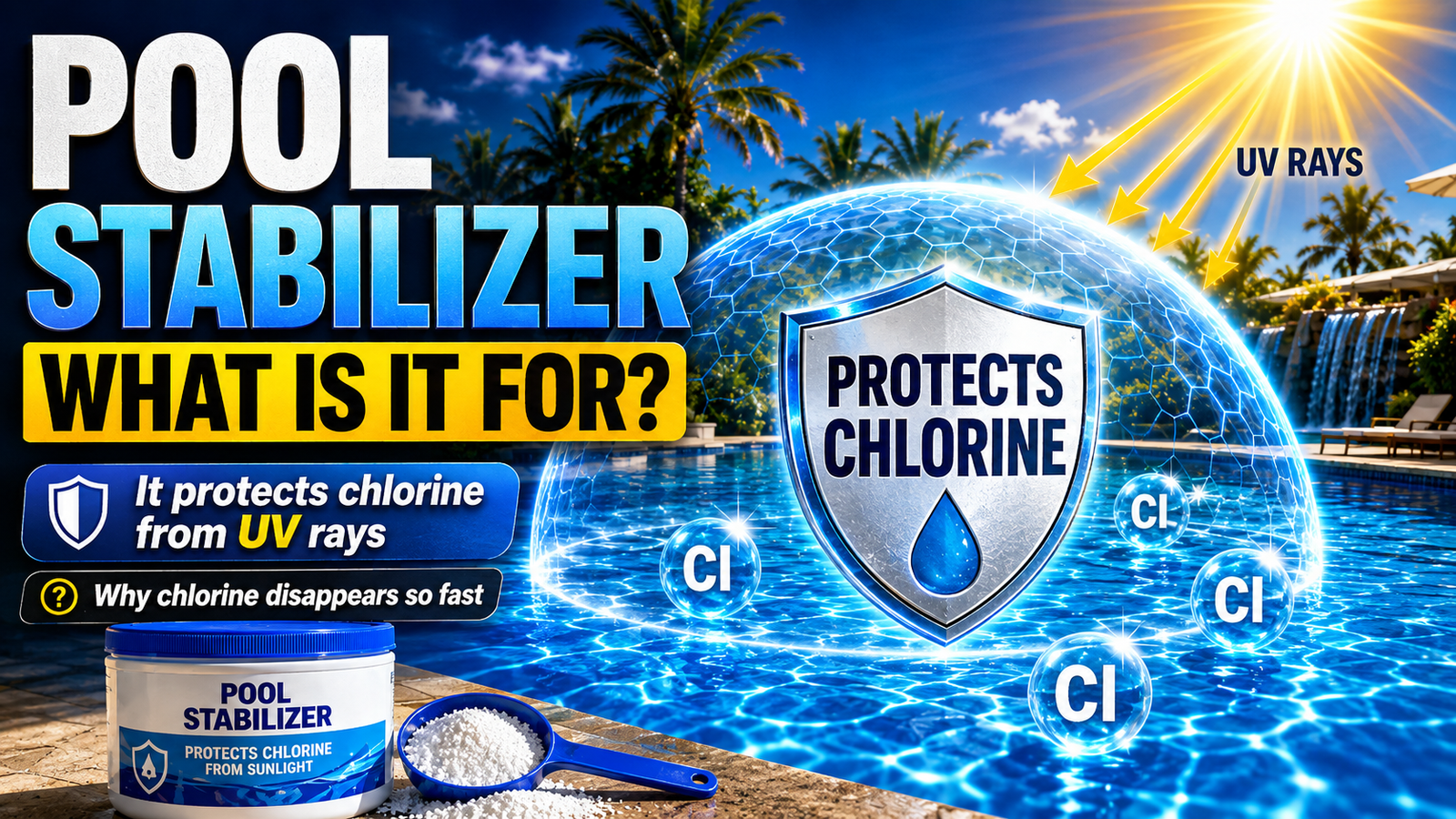
Keeping large volumes of crystal-clear water under a scorching sun seems like an act of magic, but in reality, it is a delicate chemical balance. When ultraviolet rays hit a treated aquatic surface, a silent and destructive reaction occurs. This is where a fundamental piece of the puzzle comes into play: cyanuric acid.
Although the technical term sounds complex, its primary function is to act as a molecular anchor. But to truly understand the magnitude of its importance, it is necessary to observe what happens at a microscopic level when water, the sun, and disinfectants interact.
The chemistry behind the shield
Chlorine is an aggressive and highly effective disinfectant, but it has a fatal weakness: it is photodegradable. Without any protection, the sun’s ultraviolet radiation breaks the chemical bonds of free chlorine, turning it into a gas that simply dissipates into the air.
The main function of the stabilizer is not to create a physical “shade” over the water, as is often simplified. In reality, it forms a weak chemical bond with the chlorine molecules. This resulting compound (called chloroisocyanurate) is highly resistant to UV rays. When a contaminant or bacteria enters the water, the stabilizer “releases” the chlorine molecule, allowing it to do its disinfecting work.
Fascinating facts that occur beneath the surface
Most basic literature stops at the “sunscreen for water” analogy, but the real dynamics of the stabilizer hide chemical behaviors that are rarely mentioned:
- The 120-minute rule: In an environment exposed to direct sunlight, without a single particle of stabilizer in the water, UV rays are capable of destroying up to 90% of active chlorine in just two hours. It is the equivalent of all the disinfecting power disappearing before noon.
- Molecular kidnapping (Chlorine lock): A little-known concept is that an excess of this substance is just as problematic as its absence. Because the stabilizer binds to chlorine, if the concentration of cyanuric acid rises too high, it refuses to “release” the chlorine when there is a threat. A body of water can register extremely high levels of chlorine on chemical tests but be completely defenseless against algae. This phenomenon is known as chlorine lock.
- It is practically immortal: Unlike common disinfectants that are consumed when oxidizing bacteria or that evaporate with heat, the stabilizer does not evaporate. It does not degrade with friction, with the passage of time, or with sunlight. Once it enters the aquatic system, it stays there. The only real, physical way to reduce its levels in a closed system is by extracting old water and replacing it with new water.
- The Trojan horse in solid tablets: There is a belief that this compound must always be added manually and separately. However, slow-dissolving solid disinfectant tablets (chemically known as dichlor or trichlor) are manufactured with nearly 50% stabilizer in their composition to maintain their solid form. Every time a tablet dissolves, it introduces more stabilizer to the water, creating a silent cumulative effect over the months.
Understanding the function and behavior of this compound completely transforms the way water maintenance is perceived. It is not just about adding chemicals randomly, but about managing an invisible choreography where each element must be kept in exact proportions for the system to survive the natural elements.