Ecosystem of a green pool

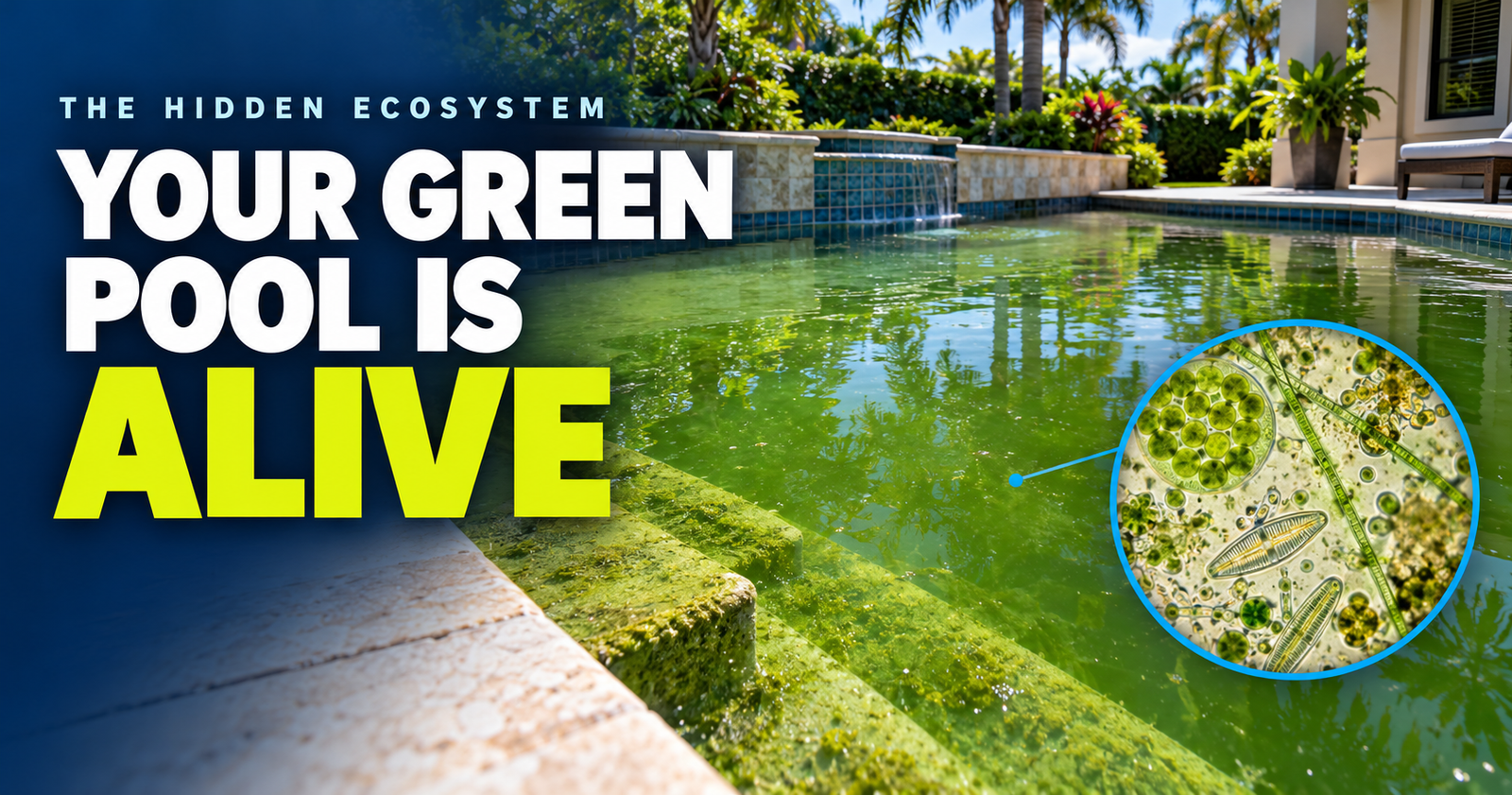
When pool water loses its clarity and takes on an emerald or swampy hue, it hasn’t simply “gotten dirty.” What is actually taking place in a green pool ecosystem is a complete biological transition: an artificial, sterile body of water has been reclaimed by nature, turning into a living, complex, and self-sustaining habitat.
Understanding how a green pool ecosystem operates from the inside out explains why randomly dumping jugs of chlorine rarely solves the root problem, and reveals what is truly happening at a microscopic level.
The invisible awakening: how the green pool ecosystem begins
There is a popular belief that algae appear out of nowhere when it rains or gets hot. The reality is far more intriguing: a clean, crystal-clear pool already contains algae spores at all times. These microscopic particles travel on the wind, in the rain, and even on swimsuits, remaining in a state of dormancy or “biological sleep” as long as sanitizer levels keep them at bay.
The ecosystem wakes up when three factors converge, acting as a biological switch:
- Sanitizer depletion or lock: Free chlorine drops below its protective threshold or becomes immobilized by an excess of stabilizer (cyanuric acid). In this phenomenon, technically known as chlorine lock, water tests may show plenty of chlorine present, but it is chemically “handcuffed” and unable to attack microorganisms.
- The invisible feast (Phosphates and Nitrates): Falling leaves, dust, pollen, nearby lawn fertilizers, and even sweat break down in the water, releasing phosphates and nitrates. While undetectable to the naked eye, to dormant spores they are the equivalent of fast-acting fertilizer.
- Sunlight and thermal stagnation: When water stops circulating enough, warm surface layers form (thermal stratification). Heat accelerates the spores’ cellular metabolism, allowing them to double in population within hours rather than days.
The hidden architecture of the green pool ecosystem: the biofilm shield
One of the least-known facts about green pools is that the real enemy isn’t the green tint floating in the water, but what clings to the walls.
Before turning the entire pool green, microbial colonies build a biofilm. This is that slippery or slimy sensation felt when touching the steps or walls of a neglected pool.
This layer is not mere dirt; it is an extracellular polymeric matrix (a shield of sugars and proteins) secreted by bacteria and algae to protect themselves. This physical barrier is so dense that regular liquid chlorine simply slides right off without penetrating it. As long as the biofilm remains intact on the walls, the colonies living underneath will keep reproducing and releasing new cells into the water, no matter how many chemicals are poured into the surface.
The pond inhabitants: three levels of invasion
As the ecosystem matures, different species compete or collaborate for space and nutrients. Not everything living in a green pool is the same:
1. Heterotrophic bacteria (The pioneers)
Before the water turns green, it first becomes cloudy or milky. This happens because bacteria multiply much faster than algae. They consume the very last traces of available chlorine, paving the chemical way for algae to bloom without resistance.
2. Green algae (Chlorophyta)
These are responsible for the classic pea-soup color. They float freely in the water column and have an explosive reproduction rate fueled by photosynthesis. Under ideal sunlight and nutrient conditions, a green algae population can double its biomass every few hours, consuming all available oxygen and chlorine in its path.
3. Cyanobacteria (The misnamed “black algae”)
When a pool has been neglected for a long time or suffers from chronic circulation issues, dark spots appear embedded in the surface finish. A fascinating fact is that “black algae” isn’t actually algae at all, but a prehistoric photosynthetic cyanobacterium. It develops microscopic “roots” that bore into the pores of plaster, concrete, or tile grout, and forms a waxy, waterproof cap on the surface—making it nearly immune to standard chemical treatments unless its outer cap is mechanically broken first.
The chemical paradox: why the pool defends itself
Once a pool is completely green, the ecosystem enters a cycle of chemical self-defense that baffles most people.
During the day, as millions of algae cells perform photosynthesis, they consume the carbon dioxide ($CO_2$) dissolved in the water. Because carbon dioxide forms carbonic acid in water, removing this gas causes the pool’s pH to skyrocket to highly alkaline levels (above 8.0).
This triggers a critical chemical phenomenon: chlorine in water splits into two forms—hypochlorous acid (the active form that actually kills algae) and the hypochlorite ion (which is very slow and weak).
- At a balanced pH (7.2), chlorine packs a high destructive punch.
- At a high pH (8.2 or above, driven up by the algae themselves), less than 15% of the added chlorine remains active.
In short, the algae’s own metabolism alters the water chemistry to deactivate the very chlorine used against them. Furthermore, dead cells left floating act as “chemical sponges,” absorbing freshly added chlorine before it can ever reach the live algae deeper down.
Ecological succession: how the green pool ecosystem becomes a true swamp
If left uninterrupted, within a few weeks the ecosystem evolves from a microbial culture into a visible food web:
- Primary producers: Algae and phytoplankton dominate the water and block sunlight from reaching the floor.
- Primary consumers: Aquatic insects arrive and mosquitoes lay their larvae, which feed directly on suspended bacteria and microalgae.
- Predators: Water beetles, dragonflies, aquatic bugs (such as backswimmers), and eventually amphibians like frogs and toads show up, drawn by the abundance of insects.
- Anoxic zone (The dark bottom): On the pool floor, where sunlight can no longer reach, dead algae and leaves accumulate into an organic sludge. Anaerobic bacteria (which thrive without oxygen) flourish here, breaking down matter and releasing sulfur and methane gases—responsible for the distinct swamp or rotten-egg smell in severely neglected pools.
Conclusion
A green pool is not simply dirty water in need of more chemicals; it is a living, organized ecosystem that actively modifies its environment to survive. From building protective biofilm shields to altering pH through photosynthesis, microorganisms work together to neutralize surface-level sanitization attempts. Understanding this biological dynamic shows that recovering the water isn’t a brute-force war of dumping endless jugs of chlorine, but a strategic process of dismantling the physical and chemical defenses keeping that habitat alive.
Final recommendations to break the green pool ecosystem cycle
To effectively dismantle this ecosystem—or prevent it from forming again—it is essential to follow a methodical, step-by-step approach:
- Break the physical shield before adding chemicals: Never shock a pool without vigorously brushing all walls, steps, and corners first. Mechanical brushing destroys the slimy biofilm, leaving algae and bacterial colonies exposed to the sanitizer.
- Lower the pH before chlorinating: Because algae raise the pH to protect themselves, the first chemical step must be adjusting the pH down to around 7.2. Doing this immediately multiplies the killing power of the chlorine added afterward, saving both time and product.
- Cut off the food supply (Phosphates): Once algae are killed, their burst cells release all the phosphates they consumed right back into the water. Vacuuming debris off the floor (preferably directly to waste to avoid overwhelming the filter) and keeping phosphate levels in check prevents the pool from turning green again just days later.
- Maintain continuous circulation during recovery: The filtration system should run 24 hours a day while recovering the water, accompanied by frequent filter cleanings. Constant water movement keeps spores from settling and distributes sanitizer into deep, shaded areas.
- Check the stabilizer level: If the pool has been fed stabilized chlorine tablets for months or years, testing the cyanuric acid level is essential. If the level is excessive, the chlorine will remain locked, requiring a partial water drain and refill to restore real sanitizing power.
If your pool is already turning into a green pool ecosystem, our pool service team can help you reset it, so contact us today. For safe swimming guidance, see the CDC healthy swimming resources.