Tap water for your pool or special water

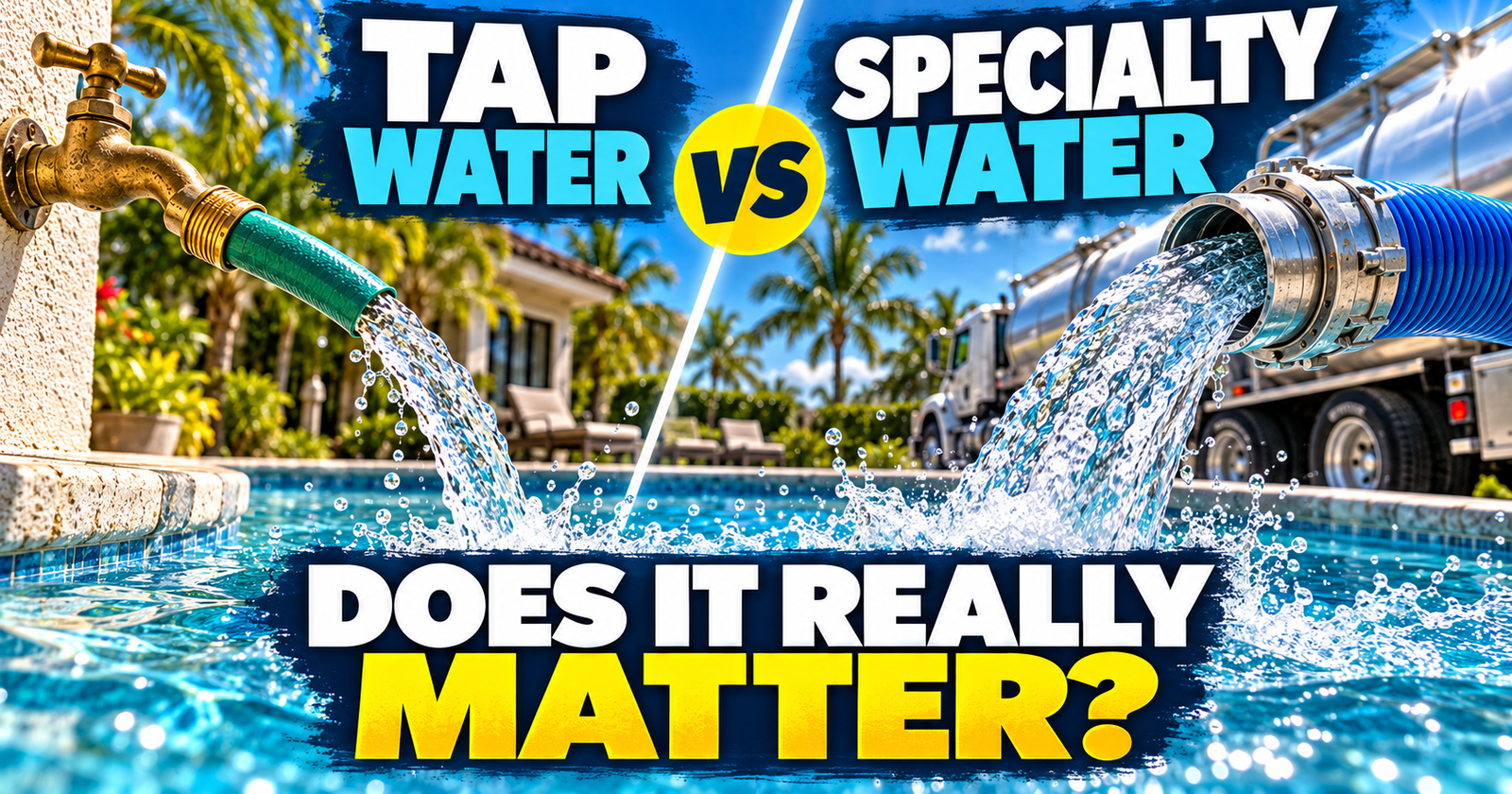
When considering tap water for pool filling, the water coming out of a garden hose looks perfect at first glance: it is clear, odorless, and completely safe to drink. However, what is safe and healthy for the human body in an eight-ounce glass behaves in a completely different way when 15,000 or 20,000 gallons sit under direct sunlight.
When filling a pool from scratch or topping off water lost to evaporation, a fundamental question arises: is it enough to turn on the household spigot, or is it worth hiring water delivery trucks with pre-treated water? The short answer is that tap water for pool use works in most cases, but it hides an invisible chemistry that—if not understood from the very first minute—can tint the pool strange colors or silently wear down its surface.
The invisible cocktail in tap water for pool filling
Municipal treatment plants engineer water so that it reaches homes clean without corroding city pipes. To achieve this, they add compounds that are rarely mentioned in basic maintenance guides, yet completely transform how a freshly filled pool behaves:
- Orthophosphates for corrosion control: Many water utilities inject phosphates into the public supply because they create a microscopic protective layer inside the city’s metal and lead pipes. The catch is that once inside a pool, phosphates are literally the primary fertilizer for algae. Filling a pool with tap water often means starting the season with a full buffet laid out for green water, even before anyone takes a swim.
- Chloramines instead of free chlorine: To ensure disinfectant survives miles of underground travel without evaporating, municipalities often use chloramine (a mixture of chlorine and ammonia) rather than pure chlorine. In a pool, chloramines do not sanitize effectively; instead, they are responsible for that harsh “chlorine smell” and eye irritation, while also locking up the effectiveness of any fresh chlorine added afterward.
- Invisible dissolved metals: Tap water—and especially residential well water—frequently carries iron, copper, and manganese. While inside the pipe, they are invisible because they remain dissolved in solution. The exact moment chlorine hits the pool, an oxidation reaction takes place: the water turns a clear emerald green, rusty brown, or even purple within minutes—not because of algae, but because the metals literally “rust” while suspended in the water.
The silent danger of overly pure water
There is a common myth that the purer and more filtered the water used to fill a pool, the better the outcome. Because of this, some consider using softened water (run through household water softeners) or reverse-osmosis purified water. In practice, filling a pool entirely with this type of water is one of the most expensive mistakes for a pool’s structure.
Water has a little-known physical property: it seeks mineral balance at all costs. Water requires a specific amount of dissolved calcium to remain “satisfied” (technically measured as calcium hardness).
If a pool is filled with “soft” or demineralized water lacking calcium, the water becomes aggressive and calcium-starved. To satisfy that mineral deficit, it will begin dissolving and eating away calcium from wherever it can find it: the plaster finish, the tile grout, decorative coping stones, and even the metal heat exchangers inside pool heaters. Conversely, water overloaded with minerals will do the exact opposite, dropping excess calcium as rough white scale across the walls.
What special pool water actually is
Ordering “special water” via dedicated pool water delivery trucks does not mean receiving magical or distilled water. It is municipal or spring water that has undergone prior industrial filtering and balancing to save weeks of chemical adjustments:
| Factor | Tap / Garden hose water | Residential well water | Special water (Pool delivery truck) |
| Heavy metals | Variable (iron and copper from aging pipes) | Very high (extreme risk of surface staining) | Pre-filtered or chemically neutralized |
| Phosphates (algae food) | High (added to protect municipal pipes) | Low, though often high in agricultural nitrates | Minimal or strictly controlled |
| Calcium balance | Depends on local geology | Almost always extreme (very hard or acidic) | Pre-balanced to the ideal range (200–400 ppm) |
| Filling speed | Slow (24 to 72 continuous hours) | Slow (high risk of burning out the well pump) | Immediate (1 to 3 hours) |
Beyond water chemistry, filling speed plays a major structural role. In pools with freshly applied plaster or quartz finishes, filling slowly with a garden hose—letting the stream hit a single spot or pausing the flow halfway—creates a permanent “bathtub ring.” This permanent watermark forms on the wall because the material cures at different rates when exposed to air versus water. Trucked-in water floods the shell rapidly and evenly, preventing aesthetic scarring on brand-new surfaces.
Conclusion
Using tap water for pool is a perfectly viable and cost-effective option for filling or topping off a pool, provided the local supply does not come from a metal-heavy well or pass through severely aging urban pipes. However, assuming tap water is chemically “neutral” simply because it is drinkable leads to misdiagnosis when the pool changes color on day one. On the other hand, special trucked-in water is not an unnecessary luxury, but a technical solution designed to protect new surfaces, prevent residential well pumps from burning out, and deliver a chemically stable baseline from the very first hour.
Final recommendations on tap water for pool use
- Test the hose water before turning it on full blast: Before pouring thousands of gallons into the pool, fill a clean bucket with tap water and run a quick test for metals, phosphates, pH, and calcium hardness. Knowing what comes out of the tap ahead of time prevents costly surprises.
- Attach a hose pre-filter when filling from home: Affordable purifying canisters screw directly onto the end of a standard garden hose. These trap a significant portion of copper, iron, and heavy calcium before they ever touch the pool.
- Add a metal sequestrant before adding chlorine: When using tap or well water, the very first product added to the water should never be chlorine, but rather a metal sequestrant. This liquid binds to microscopic iron and copper particles so they cannot oxidize or stain the walls when sanitizer is finally introduced.
- Wrap the hose nozzle in a clean white cloth: When filling an empty pool, never leave a brass hose fitting resting directly on the pool floor; water vibration scratches the finish, and the brass fitting leaves an instant round rust stain. Tying a clean white sock or rag around the end cushions the impact and protects the surface.
- Never turn off the water halfway through: When using a household hose to fill an empty pool, the water flow must remain continuous until it reaches the middle of the top waterline tiles (the skimmer level). Stopping the fill allows the sun to dry the damp edge, leaving a permanent mineral ring around the entire perimeter.
Not sure whether tap water for pool filling is right for your property? Our pool service team can test your water, so contact us before you fill. For background on water quality, see the CDC healthy swimming resources.