What You Don’t See in the Water: The True Value of a Professional Cleaning Service

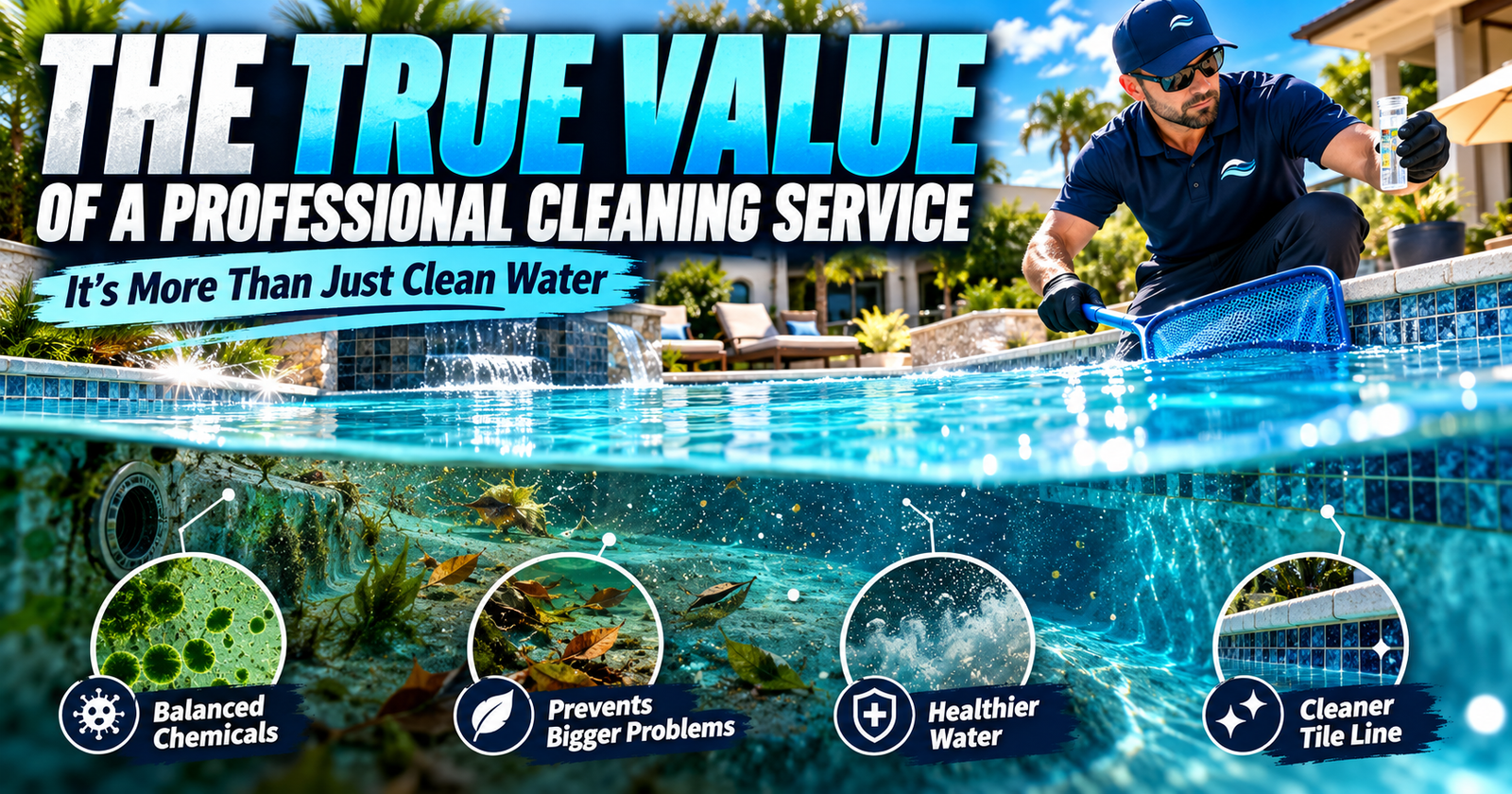
Maintaining a pool with a crystal-clear appearance is often perceived as a purely visual and mechanical task: if there are no leaves floating and the water looks blue, it is assumed that everything is in perfect condition. However, beneath that calm surface operates a highly unstable chemical and biological ecosystem. Proper water management is not about reacting when it turns green, but about maintaining an invisible mathematical balance that fully justifies delegating the task.
Below is a breakdown of the true technical reasons that occur at a microscopic level in the water, demonstrating why pool chemistry is an exact science.
“Hungry” Water and the Langelier Saturation Index (LSI)
It is common knowledge that pH and chlorine levels must be measured. However, the true indicator of water balance is the Langelier Saturation Index (LSI). This index evaluates the relationship between water temperature, calcium hardness, total alkalinity, pH, and total dissolved solids.
If the LSI level drops into negative numbers, the water becomes “hungry” or corrosive. Because water always seeks its own balance, it will begin to extract calcium from the pool walls, eroding the plaster and tiles, and destroying the metal components of pumps and heaters. Conversely, if the LSI is too high, the water will deposit scale in the pipes, reducing flow and burning out motors. Achieving a neutral LSI requires precise calculations that go far beyond traditional test strips.
Chlorine Lock and the Cyanuric Acid (CYA) Trap
A very common mistake in amateur maintenance is the continuous use of commercial chlorine tablets. These tablets contain a stabilizer called cyanuric acid (CYA), which acts as a “sunscreen” so the sun does not evaporate the chlorine in a matter of hours.
The technical fact that almost no one knows is that, while chlorine is consumed when killing bacteria, cyanuric acid never evaporates; it simply accumulates in the water month after month. When CYA levels exceed 50 parts per million (ppm), a phenomenon called “chlorine lock” occurs. The water can be full of chlorine, but it becomes completely inactive. Bacteria and algae will begin to proliferate in water that, paradoxically, is saturated with chemicals. The only mathematical way to solve this is not by adding more products, but by knowing how to calculate exactly what percentage of water must be drained to restore chemical viability.
The “Clean Smell” Illusion and the Formation of Chloramines
There is a strong cultural myth dictating that if a pool smells heavily of chlorine, it means it is very clean. Scientifically, exactly the opposite is true. Free chlorine in its pure state is odorless.
That strong irritating smell that reddens eyes and dries the skin is the result of chloramines (or combined chlorine). Chloramines form when free chlorine binds to ammonia present in sweat, body oils, and microscopic debris. A strong “pool smell” is the technical signal that the water has run out of useful chlorine and is full of toxic byproducts. Eliminating chloramines requires a precise chemical process called “breakpoint chlorination,” where the combined chlorine level must be calculated and multiplied exactly by ten to oxidize and destroy the chloramines at their root, releasing them from the water as nitrogen gas.
Biofilms: Microscopic Fortresses on the Walls
At first glance, pool walls may appear clean, but bacteria and algae spores have an advanced survival mechanism: they create biofilms. This is a microscopic, slimy layer that acts as an impenetrable protective shield against regular chemicals.
If mechanical friction is not applied with the right type of brush (depending on the pool material) combined with the use of specific enzymes that break down the organic structure of the shield, bacteria will live and multiply underwater regardless of how much chlorine is thrown on top.
Conclusion
Water management is a discipline that combines principles of hydrodynamics, thermodynamics, and inorganic chemistry. Keeping a pool safe is not about cleaning what is visible, but about controlling the invisible reactions that happen every second. The difference between simply clear water and chemically balanced water lies in advanced technical knowledge about saturation, chemical lock, and the eradication of toxic byproducts; factors that guarantee both the health of the aquatic environment and the long-term structural integrity of the equipment and surfaces.
Final Recommendations
- Monitoring beyond pH: Ensure that weekly measurements include tests for total alkalinity and calcium hardness to correctly calculate the Langelier Saturation Index (LSI).
- Chemical rotation: Avoid exclusive reliance on stabilized chlorine tablets (trichlor) to prevent the excessive accumulation of cyanuric acid (CYA), alternating with liquid chlorine (sodium hypochlorite) when necessary.
- Strategic brushing: Implement a strict routine of brushing walls, steps, and hard-to-reach corners at least once a week to destroy biofilms before they require aggressive chemical interventions.
- Attention to olfactory signals: If the area begins to emit a strong chemical odor, the combined chlorine level must be evaluated immediately to execute a calculated superchlorination, rather than mistakenly assuming the water is sanitized.