Does a clarifier turn my green pool blue?

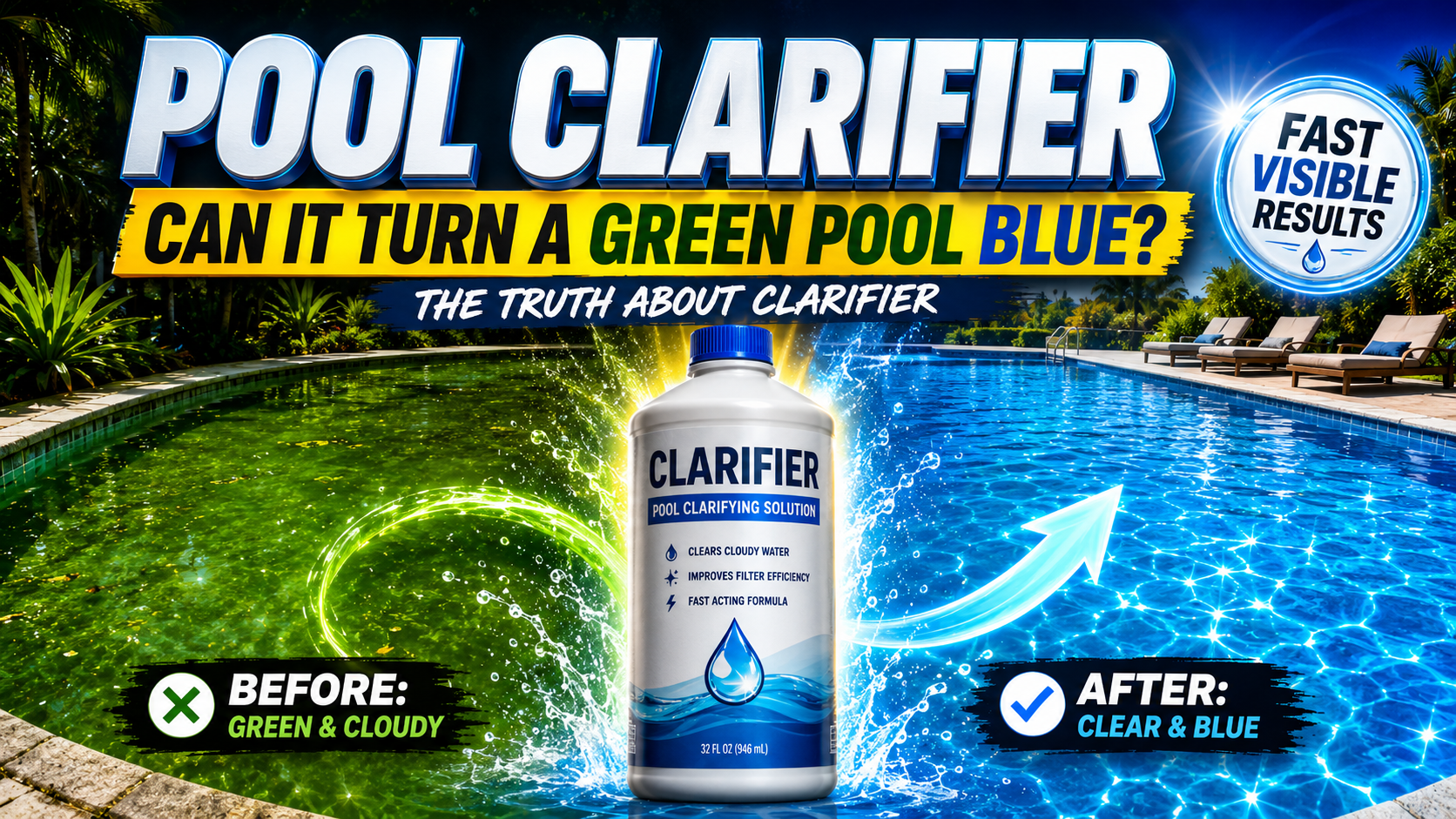
When pool water takes on a murky, green hue, the most common reaction is to look for a quick fix. In this scenario, a clarifier is often seen as a miracle product capable of restoring the water’s crystal-clear blue color. However, the chemistry behind aquatic maintenance reveals a very different and fascinating reality.
To understand if this product truly works magic, it is necessary to analyze what happens at a microscopic level and debunk some of the most deeply rooted myths about water treatment.
How does a clarifier actually work?
To simplify a complex chemical process, a clarifier can be thought of as a set of tiny liquid magnets. Cloudy water is filled with microscopic particles (dust, oils, organic debris) that are too small to be trapped by the filtration system.
These particles have an electrical charge that causes them to repel each other, keeping them suspended in the water. The clarifier introduces polymers with an opposite charge. Their function is to neutralize these charges and act like glue, clumping the microscopic particles into larger clusters. Once these clusters reach a sufficient size, the filter can finally catch them.
The myth of green to blue: The definitive answer
The direct answer to the question is no. A clarifier alone will not turn green water blue.
The green color in the water generally indicates the presence of a living organism: algae. A clarifier is not an algaecide or a sanitizer; it does not have the ability to eliminate living organisms. If a clarifier is poured into a pool full of living algae, the particles will clump together, but the algae will continue to reproduce, and the water will remain green.
The true process to recover the blue color requires a strict sequence:
- Elimination: First, a shock treatment (usually with chlorine) must be applied to eradicate the algae.
- Color change: Upon dying, the algae change from green to a gray or whitish hue, leaving the water extremely cloudy.
- Clarification: It is in this final stage that the clarifier comes into play, clumping the lifeless organic debris together so the filter can clean the water and reveal the blue color.
Little-known facts about clarifiers
Water management hides technical secrets that are rarely mentioned on product labels. Here are details that completely change how clarification is understood:
- The “overdose” effect worsens the problem: There is a widespread belief that applying more product will yield faster results. In the case of a clarifier, the exact opposite happens. If too much is added, the polymer chains saturate the water and begin to repel each other again. The result is permanently cloudy water that often requires a partial drain to be corrected.
- Green water is not always synonymous with algae: Sometimes, the water takes on a bright green hue, but is completely transparent (no cloudiness or slippery walls). In these cases, the problem is not algae, but the oxidation of metals, such as dissolved copper in the water. A traditional clarifier is useless against dissolved metals; a specific sequestering agent is required to clump minerals together.
- Absolute dependence on pH: Clarifiers are extremely sensitive to chemical balance. If the water’s pH is too high or too low, the clarifier’s molecular chains break upon contact with the water. The product will simply disintegrate without clumping a single particle, completely wasting the treatment.
The true secret behind crystal-clear water does not lie in a single product, but in understanding and respecting the order of chemical processes. A clarifier is an exceptional tool, but only when used at the exact right moment and under the proper conditions.