Real costs of cleaning the pool on your own or leaving it to an expert company

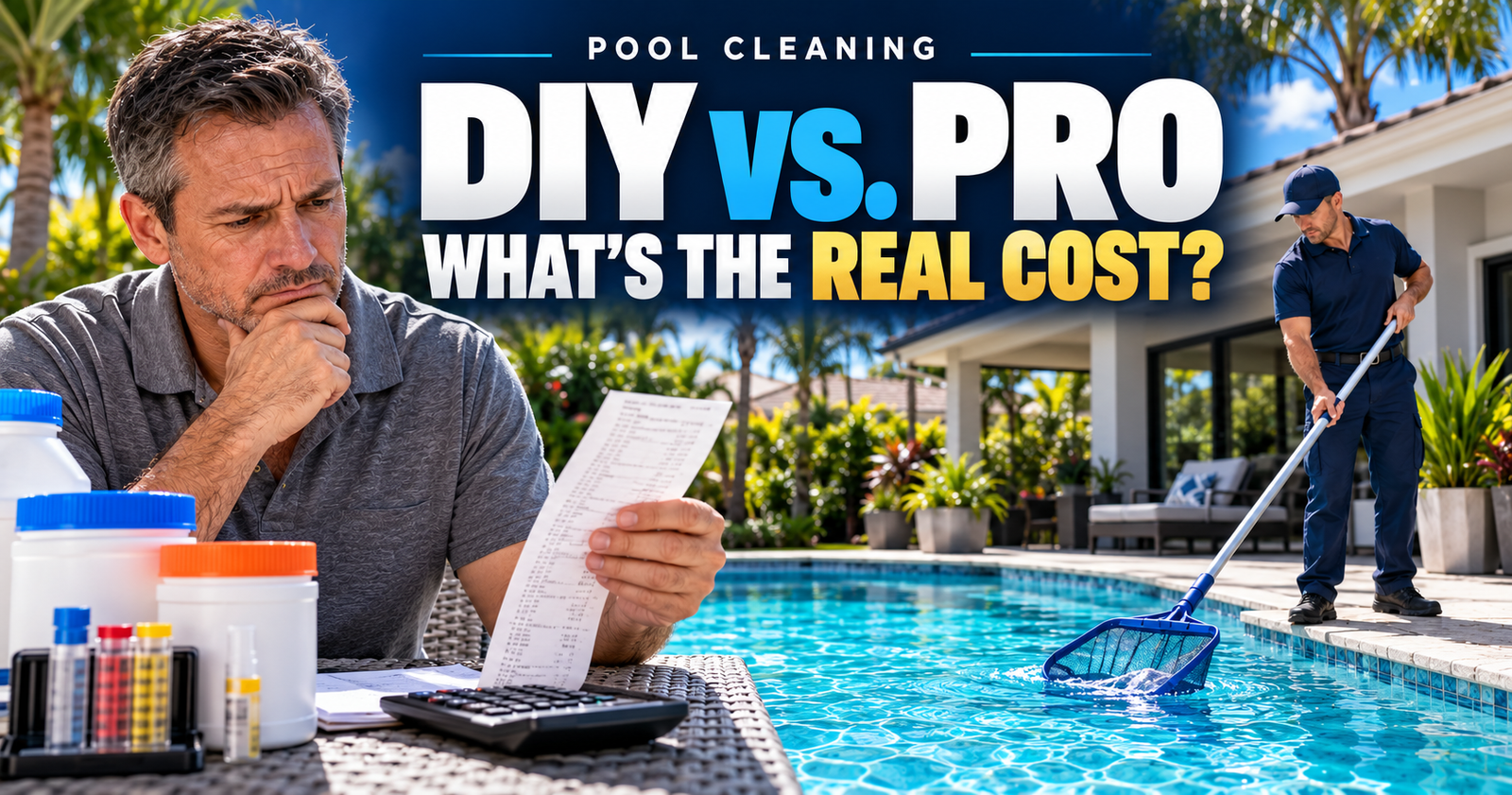
When calculating the monthly budget for a home with a pool, there is a common belief that the DIY pool cleaning cost is low, because handling the maintenance yourself is synonymous with immediate savings. At first glance, the math seems simple: buy a couple of buckets of chlorine, skim the leaves out with a net on the weekends, and run the pump for a little while each day.
However, pool water is not a static pond; it is a constantly changing chemical ecosystem that reacts to the sun, rain, dust, and even the sweat of those swimming in it. When looking at the big picture over the course of a year, the financial difference between DIY pool cleaning cost and delegating it to expert hands does not lie in what a chlorine tablet costs, but in the invisible chemistry and cumulative mistakes that go unnoticed until the expense becomes unavoidable.
The hidden expense of retail chemicals in your DIY pool cleaning cost
One of the biggest money drains in DIY maintenance happens right in the store aisle. Chemical products sold to the general public often have different concentrations and inflated prices compared to commercial-grade supplies. Yet the true hidden cost is not the price tag on the container, but what that container does to the water in the medium term.
The “chlorine lock” trap (cyanuric acid)
To keep the sun from destroying chlorine within a couple of hours, commercial trichlor tablets include a component called cyanuric acid (CYA), which acts like sunscreen for the sanitizer. Here lies the first fact that is rarely mentioned: while chlorine is consumed as it eliminates bacteria and organic matter, this stabilizer neither evaporates nor disappears. It stays behind and accumulates in the water.
Over the months, as more tablets are added without measuring this stabilizer, the level rises so high that it ends up “hijacking” the new chlorine. This phenomenon is known as chlorine lock. The homeowner tests the water, sees there is plenty of chlorine, yet the pool wakes up green. The natural reaction is to spend an extra $80 or $100 on shock treatments, algaecides, and clarifiers that will do absolutely nothing because the stabilizer is preventing the chlorine from working. The only real solution at that point is to partially drain the pool and refill it, driving up the water bill and forcing a complete chemical rebalance from scratch.
The rebound effect of test strips
DIY maintenance usually relies on paper test strips to measure pH and chlorine. These strips have a wide margin of error and degrade easily with ambient humidity. A miscalculation of just 0.4 points in pH has a direct financial impact:
- If the pH rises to 7.8, chlorine loses nearly half of its sanitizing effectiveness. In other words, for every $10 of chlorine poured into the water, $5 is wasted without doing any work.
- If the pH drops below 7.0, the water becomes acidic, even though it may look perfectly crystal clear to the naked eye.
“Hungry” water and the silent wear on the structure
There is a chemical concept called the Langelier Saturation Index (LSI), which in simple terms measures how balanced the water is regarding calcium. Water needs a certain amount of dissolved minerals to remain “satisfied.”
When someone cleans a pool without measuring calcium hardness or total alkalinity, it is very common for the water to enter an aggressive or “hungry” state. Unable to find the calcium it needs floating in the liquid, the water begins to steal it from wherever it can:
- From the pool surface: It slowly dissolves the plaster or the grout between the tiles, making the walls rough to the touch and shaving years off the lifespan of the surface.
- From internal components: It corrodes the mechanical seals of the pump and the internal metal parts of the circulation system.
The most deceptive part of this process is that unbalanced, acidic water often looks incredibly transparent and sparkling. Whoever is taking care of it thinks they are doing a flawless job because the water looks like a mirror, unaware that the very same water is eating away at the finish from the inside out—creating premature wear that costs thousands of dollars in long-term resurfacing.
The electric bill and filter hydraulics behind DIY pool cleaning cost
Another invisible expense in DIY maintenance lies in electricity consumption. The heart of the pool is its filtration system, and a dirty filter does more than just let particles pass through; it completely alters the hydraulic pressure inside the plumbing.
When the filter’s cartridge, sand, or diatomaceous earth (D.E.) becomes saturated with body oils, sunscreen, and microscopic dust, water flow is restricted. This forces the pump motor to work harder just to move the same volume of water. A pump operating under high pressure consumes significantly more electricity every month and overheats, drastically shortening its lifespan.
A specialized service does more than just brush the walls and vacuum; it monitors the pressure gauge, performs backwashes or chemical cartridge cleanings the exact moment pressure rises 8 to 10 PSI above its clean baseline, and adjusts run times according to seasonal temperatures. In winter, algae metabolism comes to a near standstill, meaning the pool does not require the same filtration hours or chemical dosing as it does in the middle of July or August.
DIY pool cleaning cost: annual comparison of doing it on your own vs. expert service
To put the numbers into perspective in a real-world scenario (using an average residential pool of 15,000 to 20,000 gallons as a reference), costs over a 12-month period behave as follows:
| Expense Category | On your own (Annual estimate) | Expert company (Annual estimate) |
| Base chemicals (chlorine, acid, baking soda, calcium) | $600 – $900 USD (bought at retail prices) | Included in the monthly fee |
| Emergency chemicals (algaecides, clarifiers, extra shocks from testing errors) | $250 – $500 USD | $0 USD (prevention keeps the water from turning green) |
| Tools and replacements (nets, brushes, sun-damaged hoses, test kits) | $150 – $300 USD | $0 USD (technicians bring their own commercial-grade gear) |
| Water and power overages (draining from excess stabilizer and clogged filters) | $200 – $400 USD | Optimized to a minimum through hydraulic control |
| Time invested (approx. 2 to 3 hours weekly between shopping, testing, and physical cleaning) | 100 to 150 hours per year | 0 hours |
| Risk of premature wear (surface staining, seal corrosion from poor pH) | High (difficult to detect with the naked eye) | Very low (constant monitoring of the saturation index) |
Conclusion
Cleaning a pool on your own only looks cheaper when the math is limited to that month’s supermarket or pool store receipt. In practice, DIY maintenance tends to operate reactively: products are applied once the water has already turned cloudy or green spots have appeared on the walls—which is项目的exact moment when fixing the problem costs three times as much. Weighing DIY pool cleaning cost honestly is the first step toward a smart decision.
On the other hand, delegating care to an expert company turns a variable, unpredictable expense into a fixed, controlled rate. The true value of a professional service is not just saving someone the physical effort of vacuuming under the sun; it is the chemical precision that protects the pool surface, takes care of the pump motor, optimizes the electric bill, and ensures that every dollar of chemical product does its job without going to waste.
Final recommendations to control DIY pool cleaning cost
- Evaluate the cost of your time: Before deciding to do it on your own, calculate how many hours a month you will spend not only brushing and vacuuming, but also driving to buy chemicals, storing flammable or corrosive buckets at home, and figuring out how to rebalance the water after a heavy storm.
- Don’t trust “crystal clear” water without testing: If you decide to handle it yourself, never assume the water is healthy just because it looks clear. Invest in a liquid drop test kit (such as a Taylor reagent kit) instead of paper strips, and measure total alkalinity and calcium hardness at least once a month.
- Keep a log of “extra” expenses: If you currently clean your own pool, add up everything you spend over three months on corrective products (clarifiers, phosphate removers, algaecides, and water refills). If that number comes close to the cost of a monthly professional rate, you are losing money as well as time.
- Prioritize weekly consistency: Water chemistry does not forgive long breaks. If your lifestyle, travel, or work schedule prevents you from tending to the pool religiously on the exact same day every week, delegating maintenance to a specialized company will always be the smartest financial decision.
Wondering whether DIY pool cleaning cost really beats a professional plan? Our pool service team can give you a clear comparison, so contact us for a quote. For safe water guidance, see the CDC healthy swimming resources.