Chlorine tablets or liquid chlorine

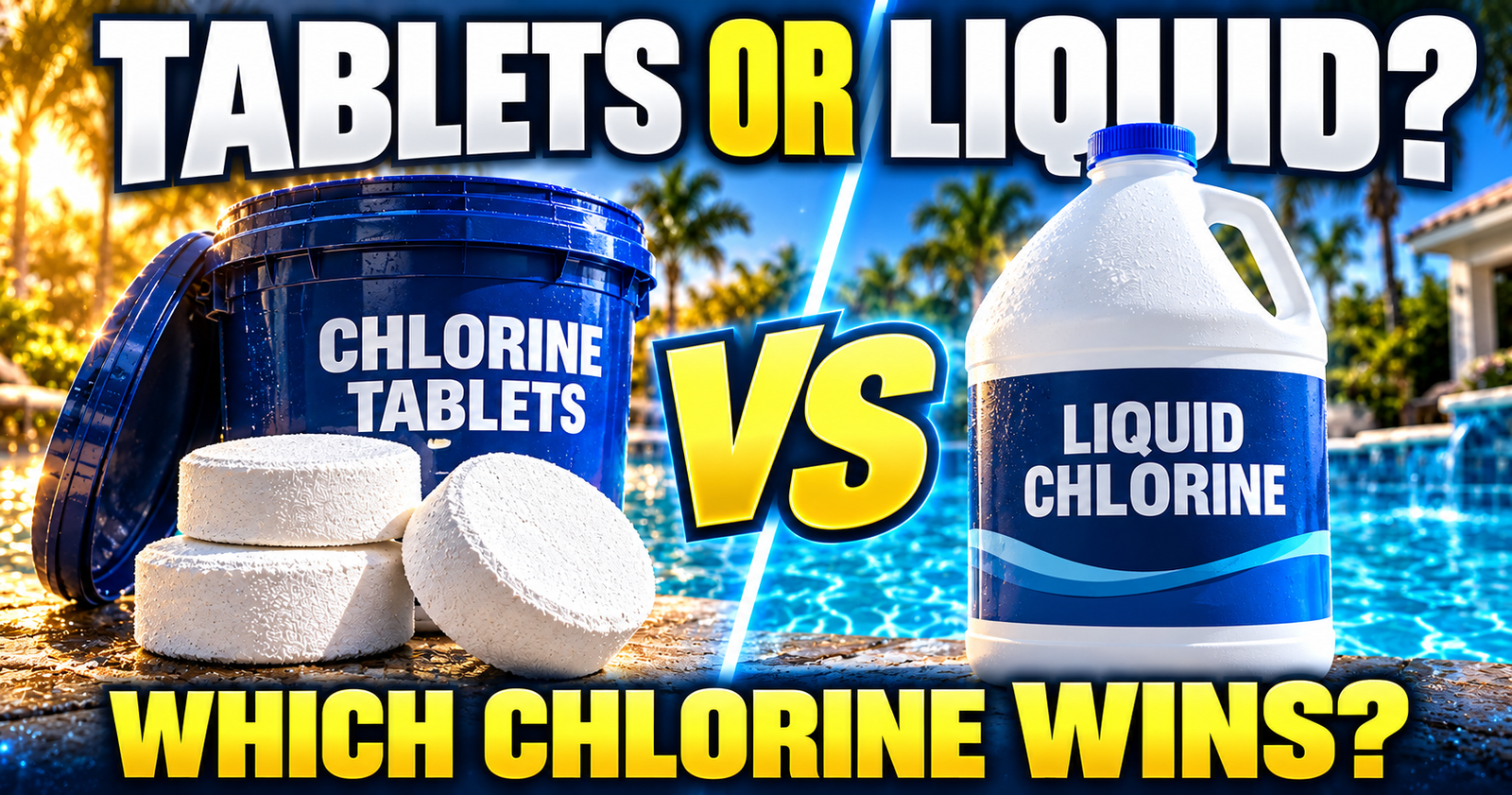
When approaching swimming pool water maintenance, a fundamental question, the classic chlorine tablets vs liquid chlorine dilemma, often arises: whether to use slow-dissolving solid tablets or pour liquid chlorine directly into the water. At first glance, both products seem to fulfill the exact same purpose of keeping the water crystal clear and free of bacteria. However, what happens at a chemical level beneath the surface tells a very different story. The difference lies not only in the physical format, but in the invisible secondary compounds that each option leaves behind as the months go by.
The real worker inside the water: hypochlorous acid
To understand the difference between both formats, one must first grasp a basic yet crucial concept: when any type of chlorine is added to the water, it transforms into a compound called hypochlorous acid. This acid is the true disinfecting agent that destroys bacteria, microorganisms, and algae.
The greatest enemy of this disinfecting agent is the sun. Ultraviolet (UV) rays act like a magnet that breaks down free chlorine in a matter of two to three hours on a sunny day. It is right here where the two products in the chlorine tablets vs liquid chlorine choice take completely opposite paths in their formulation and behavior.
Chlorine tablets: the sun shield that becomes a trap
Chlorine tablets (technically known as trichlor) are designed to dissolve slowly and withstand the sun’s impact. To achieve this, their manufacturing process includes an additional ingredient called cyanuric acid, which literally acts as a sunscreen for the chlorine. This stabilizer binds to the chlorine molecules and prevents UV rays from destroying them rapidly.
Here, three lesser-known facts about the behavior of tablets emerge:
- “Chlorine lock” (overstabilization): While chlorine is consumed as it kills bacteria and evaporates, the “sunscreen” (cyanuric acid) never evaporates. With every tablet that dissolves week after week, this stabilizer accumulates in the water. It eventually reaches a point where there is so much stabilizer that it “hugs” the chlorine too tightly and prevents it from working. The result is baffling: water tests show that the pool is full of chlorine, yet the water turns green because the sanitizer is chemically tied up. The only real solution to lower this level is to partially drain the pool and add fresh water.
- Silent extreme acidity: The trichlor in tablets has an extremely low pH, close to 2.9 (almost as acidic as lemon juice or vinegar). The continuous use of tablets constantly pushes the water’s pH and alkalinity downward, making it corrosive if not compensated for with other products.
- The hidden danger in the skimmers: Placing tablets directly into the skimmer baskets (the openings on the pool wall that suck in surface debris) is a critical yet very common mistake. When the filtration pump turns off at night, the tablet continues to dissolve in the stagnant water inside the basket. This creates a broth of hyper-acidic water that, when the pump turns on the next morning, rushes all at once through the pipes, corroding rubber seals, pumps, and metal heaters from the inside out.
Liquid chlorine: immediate power and chemical purity
Liquid chlorine (composed of sodium hypochlorite) is essentially the same substance as household bleach, but with an active ingredient concentration two to three times higher, designed for large volumes of water. Unlike tablets, it is “unstabilized” chlorine, meaning it contains no cyanuric acid.
Its behavior in the water hides particularities that are rarely mentioned:
- The high pH myth: Liquid chlorine has a very high pH, around 13, because sodium hydroxide is added during its manufacturing to keep it stable in the bottle. Many believe this will drastically and permanently raise the pool’s pH. However, a closed chemical cycle occurs: when poured in, the pH rises momentarily, but as the chlorine fulfills its function of oxidizing contaminants and is broken down by sunlight, it generates an equivalent acidic reaction that almost completely neutralizes that initial spike. In practice, its long-term net impact on pH is nearly neutral.
- The pool slowly turns into saltwater: No product disappears by magic. Every gallon of liquid chlorine poured in leaves behind common salt (sodium chloride) once the chlorine is consumed. With the exclusive use of liquid chlorine over a couple of seasons, the water accumulates a noticeable amount of minerals and salinity, which curiously gives it a softer texture to the touch, though without reaching the level of seawater.
- Heat-accelerated expiration: Unlike tablets, which can last for years stored in a sealed container, liquid chlorine is an active product that loses strength rapidly. Stored at a temperature of 86°F (30°C), it loses approximately half of its sanitizing power in just three to four months, gradually turning into simple salt water.
Chlorine tablets vs liquid chlorine: direct comparison of behavior in the water
| Feature | Chlorine tablets (Trichlor) | Liquid chlorine (Sodium hypochlorite) |
| Speed of action | Slow and progressive (days) | Instantaneous (minutes) |
| Impact on pH | Very acidic (constantly lowers pH) | Alkaline at first, nearly neutral once consumed |
| Sun resistance | High (contains built-in stabilizer) | Low (requires adding stabilizer separately) |
| Accumulated residue | Cyanuric acid (chemical blocker) | Common salt (sodium chloride) |
| Shelf life in storage | Very long (2 to 3 years in a dry place) | Short (degrades with heat and time) |
Conclusion
In the chlorine tablets vs liquid chlorine debate there is no absolute winner, as both present an inevitable chemical trade-off: tablets offer convenience in exchange for saturating the water with stabilizers and acidity over the long term, while liquid chlorine offers chemical purity and immediate action in exchange for requiring more frequent application and careful storage. The key to perfect water in the chlorine tablets vs liquid chlorine choice does not lie in choosing one and discarding the other forever, but in understanding what each one adds to the water besides sanitation, thus preventing invisible byproducts from ruining the pool’s chemical balance.
Final recommendations for chlorine tablets vs liquid chlorine
- Combine both systems strategically: Use chlorine tablets only at the beginning of the season or during vacation absences until the stabilizer (cyanuric acid) level reaches its ideal point (between 30 and 50 parts per million). Once that protective shield is reached, discontinue the tablets and maintain the pool for the rest of the year exclusively with liquid chlorine.
- Apply liquid chlorine at sunset: Pouring liquid chlorine at dusk or at night allows the product to work throughout the early morning hours, destroying bacteria and organic matter at 100% of its potency, without having to compete against the sun’s ultraviolet radiation.
- Use floating or in-line dispensers for tablets: If choosing to use tablets, always place them in a floating dispenser or an automatic chlorinator installed after all filtration and heating equipment—never directly inside the skimmer baskets.
- Buy fresh liquid chlorine and store it in the shade: Purchase only the amount of liquid chlorine that will be consumed within a three-to-four-week period, and store it in a cool, dark place to prevent heat from degrading its active concentration before it ever touches the water.
Still unsure about the right chlorine tablets vs liquid chlorine routine for your pool? Our pool service team is happy to help, so contact us for a water test. For general safety guidance, see the CDC healthy swimming resources.