How muriatic acid cleans your pool

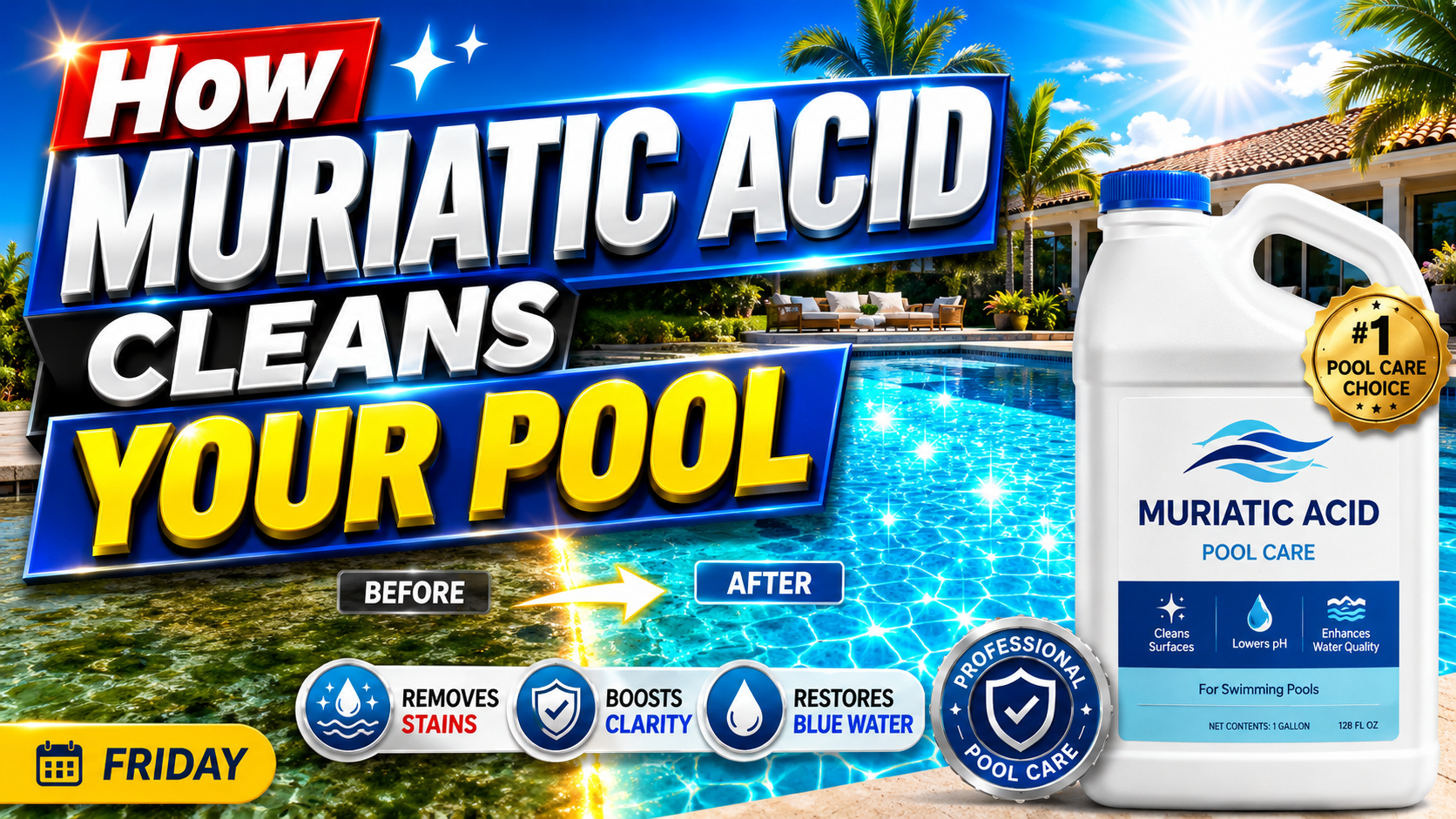
Crystal clear water doesn’t happen by magic or by the simple movement of filters; it is the result of precise chemical choreography. At the center of this delicate balance lies a powerful and often misunderstood compound: muriatic acid. Although its name may sound intimidating, its chemical function is vital to maintaining the transparency, health, and structure of any pool.
To truly understand how it works, it is necessary to look beyond the obvious and understand what happens at a molecular level when this liquid comes into contact with the water and surfaces.
The true function: Beyond lowering pH
Constantly, external elements such as liquid chlorine, the sun’s rays, and organic waste cause the water’s pH to rise, making it too alkaline. When water reaches high alkalinity levels, it loses its ability to dissolve minerals. As a result, calcium and other solids precipitate, clouding the water and forming hard scale on walls and pipes.
The job of muriatic acid is not to “clean” in the traditional sense of scrubbing away dirt. Its function is to restructure the chemical environment. When introduced into the water, the acid donates hydrogen ions, forcing solid minerals to dissolve again, restoring the water’s clarity and allowing chlorine to effectively do its disinfecting work.
Chemical facts you probably didn’t know
Traditional guides often oversimplify the use of this chemical. However, the science behind its application reveals fascinating facts:
- It doesn’t scrub stains, it removes walls: When an extreme treatment known as an “acid wash” is performed on an empty pool, muriatic acid is not simply cleaning stains off the surface. In reality, the acid is corroding and dissolving a microscopic layer of the walls’ plaster. The stains disappear because the surface holding them has been removed, revealing a completely new layer of plaster underneath.
- It attacks the shield before the target: There is a common misconception that muriatic acid immediately lowers the pH. In water chemistry, total alkalinity acts as a protective “shield” for the pH. When acid is poured in, it must first destroy the bicarbonates (the shield). Only when that shield has been sufficiently weakened does the pH level truly begin to drop.
- It’s the same chemistry as human digestion: Muriatic acid is essentially an impure, diluted form of hydrochloric acid. It is exactly the same chemical substance that the human stomach produces to break down food, just at an industrial grade designed to digest heavy minerals and calcium deposits instead of nutrients.
- The bubbling is calcium exhaling: When the acid is applied directly to the white line of scale on tiles, it begins to bubble intensely. That visual reaction is not the acid “boiling,” but rather the solid calcium carbonate instantly transforming into calcium chloride (which dissolves in water without a trace) and carbon dioxide. The bubbles are literally solid rock turning into gas and escaping into the air.
The invisible restorer
Maintaining an aquatic environment in perfect condition requires understanding the invisible chemistry that occurs beneath the surface. Without the intervention of this acid, the water in any pool would eventually become a milky, calcified environment, hostile to the materials that contain it.
Muriatic acid acts as the ultimate chemical tool. It doesn’t clean by scrubbing, but by disassembling at a molecular level the minerals that threaten to ruin the balance, ensuring the water remains a safe and perfectly transparent medium.