What are phosphates and how they affect your pool

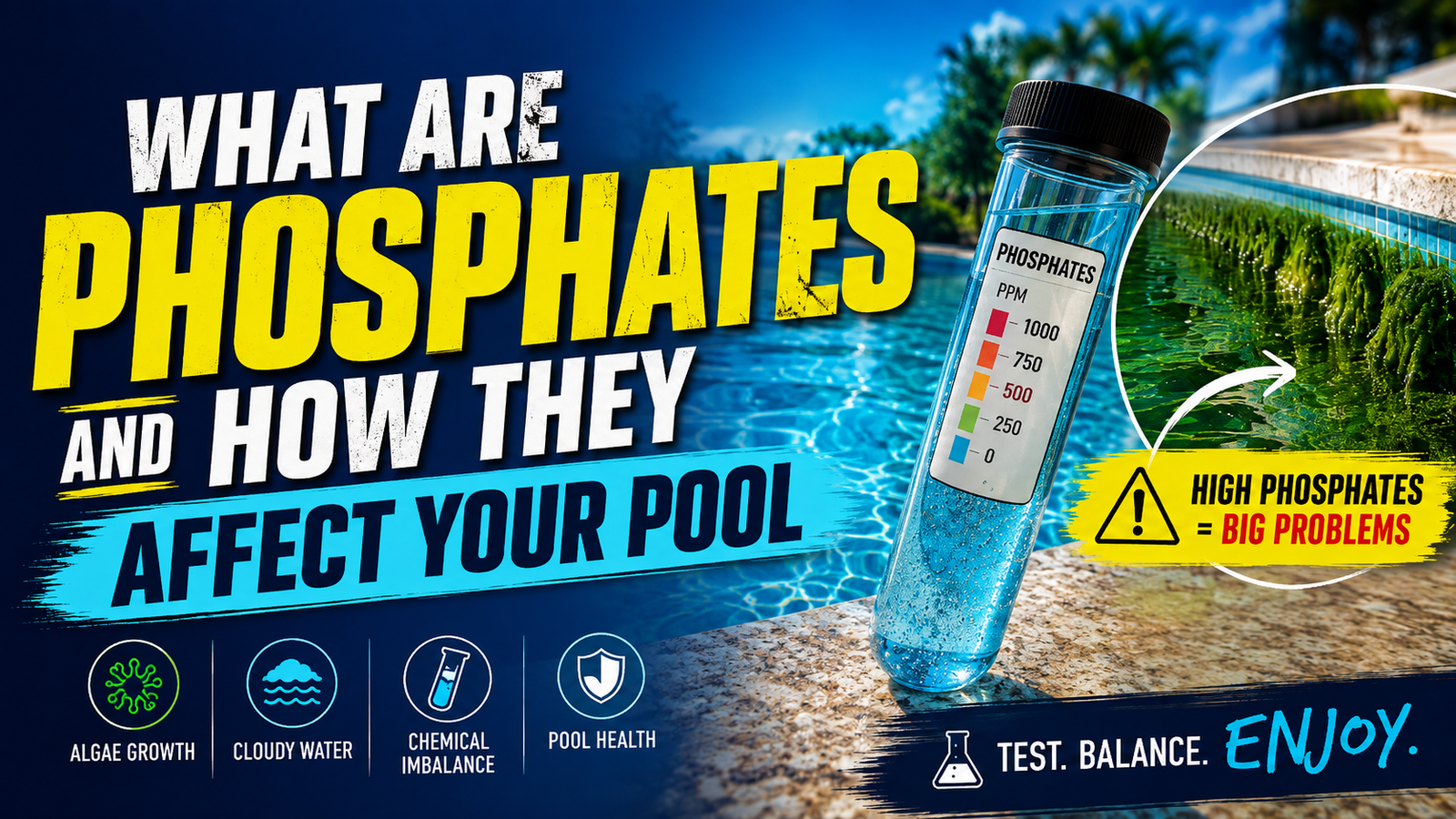
Crystal clear water can be deceiving to the naked eye. Often, chlorine and pH levels seem perfectly balanced, but the water begins to lose its sparkle or develops a greenish tint in a matter of days. Behind this almost invisible phenomenon hide phosphates.
The chemistry behind the problem
In simple terms, phosphates are chemical compounds derived from phosphoric acid. In a closed aquatic environment, they act as the highest-yield fertilizer for microorganisms. If algae spores are the seed, phosphates are the ultra-absorbing nutrient that allows them to multiply at a speed that traditional sanitizers simply cannot contain.
Although it is easy to assume that these compounds arrive exclusively through nature—such as fallen leaves, pollen, dirt, or sweat—the reality of how they enter the water is much more complex and unavoidable.
Rarely mentioned facts about phosphates
Tap water is a primary contributor
There is a common belief that public tap water is pure and does not alter water chemistry. However, municipal water treatment plants intentionally add orthophosphates to the urban supply. This process creates a protective coating inside city pipes to prevent the corrosion of heavy metals like lead and copper. Consequently, every time evaporation is compensated by filling with a garden hose, “algae food” is directly injected into the system.
The “phantom demand” for chlorine phenomenon
A common analytical mistake is thinking that phosphates neutralize or destroy chlorine directly. This is not the case. Phosphates feed microscopic algae outbreaks that are invisible to the human eye in their early stages. Chlorine is depleted at an accelerated rate trying to oxidize this constant growth. The result is a meter that reads zero free chlorine overnight, leading to the false conclusion that the sanitizer is of poor quality, when in reality it is losing a war of attrition.
The creation of destructive scaling
The damage is not limited to biological proliferation. When phosphate levels are high, they combine with dissolved calcium in the water to form a salt called calcium phosphate. Unlike common scale (calcium carbonate), this new molecular structure is extremely hard and resistant to standard acid washes. This mineral calcifies directly onto the titanium plates of salt chlorine generators and inside heat exchangers, reducing their efficiency and forcing the equipment to work with a thermal overload that shortens its lifespan.
Neutralization and physical extraction
Reducing phosphates is not achieved by adding massive shock doses of chlorine; it requires a precipitation process. Chemical formulas (usually lanthanum-based) are used that act as magnets at the molecular level. Upon contact with dissolved phosphates, they bind to them and transform them into a solid, insoluble structure.
This binding process severely clouds the water temporarily. The phosphates, now with mass and weight, fall to the bottom of the basin or get trapped, saturating the sand or filter cartridges. It is at this point that physical extraction becomes mandatory: it requires a slow, direct vacuuming to the drain (waste setting) to permanently expel the compound from the system, preventing pressure from returning it to the water.
Keeping levels under a strict threshold (ideally below 100 parts per billion) is not merely an aesthetic issue. It represents a structural barrier that protects filtration, optimizes chlorine performance, and ensures that the body of water maintains its stability regardless of temperature fluctuations.